
1. Executive Summary & Semantic Intent Alignment
In modern power electronics validation, the Regenerative AC Grid Simulator has transitioned from a specialized laboratory instrument to a mandatory core asset for global test facilities. As renewable energy integration, Vehicle-to-Grid (V2G) infrastructure, microgrids, and high-density AI data center power supplies proliferate, test engineers can no longer rely on conventional 2-quadrant linear or switching AC power sources.
Traditional AC sources act strictly as power suppliers, dissipating reverse power flow as heat or requiring expensive external resistive load banks. In contrast, a true 4-quadrant regenerative grid simulator provides full bidirectional capability: sourcing current to the Device Under Test (DUT) while absorbing reverse current and feeding up to 90%+ of that electrical energy cleanly back into the local facility mains grid.
Information Gain Insight: Sourcing vs. Sinking Energy Recovery
When evaluating grid simulators, buyers often confuse bidirectional DC power supplies with AC grid simulators. An AC Grid Simulator must control phase angle, harmonic distortion, frequency variation, voltage sags/swells, and phase imbalances simultaneously in four quadrants (P and Q active/reactive power flow), maintaining continuous synchronization with the AC grid back-plane without tripping plant circuit breakers or causing localized harmonic pollution.
2. Global Industry & Market Trends (2026–2030)
Global procurement managers and test system architects are adjusting their capital expenditure strategies to align with five major industry shifts driving the adoption of high-power regenerative grid simulation systems:
A. Grid-Tied Renewable Inverter Standards (IEEE 1547.1, UL 1741 SB, IEC 62116)
Modern smart inverters are legally mandated to support advanced grid-support functions, including anti-islanding protection, Volt-VAR control, Frequency-Watt response, and Low/High Voltage Ride-Through (LVRT/HVRT). Evaluating these dynamic compliance modes requires an AC simulator that can synthesize phase discontinuities, rapid frequency ramps (up to several hundred Hz/s), and programmable voltage transients.
B. Vehicle-to-Grid (V2G), V2H, and Bidirectional EV Chargers
With the commercial expansion of ISO 15118-20 and CHAdeMO bidirectional charging standards, Electric Vehicle Supply Equipment (EVSE) and On-Board Chargers (OBC) now operate continuously in reverse generation mode. Grid simulators must handle instantaneous transitions between sourcing power to the EV battery and sinking energy generated by the vehicle back into the grid mains.
C. AI Data Center & Megawatt Server Power Distribution
High-density AI rack installations (demanding 100kW to 600kW per cabinet) utilize advanced power distribution architectures. Test protocols demand thorough evaluation under distorted grid conditions, phase dropouts, and heavy reactive load surges. Regenerative test equipment prevents facilities from exceeding maximum demand limits while running long-duration burn-in cycles.
3. Product Recommendations & Technical Capabilities
Chroma Systems Solutions engineers scalable, ultra-reliable grid simulation instruments designed for demanding R&D and production environments. Below are recommended configurations tailored to enterprise testing needs:
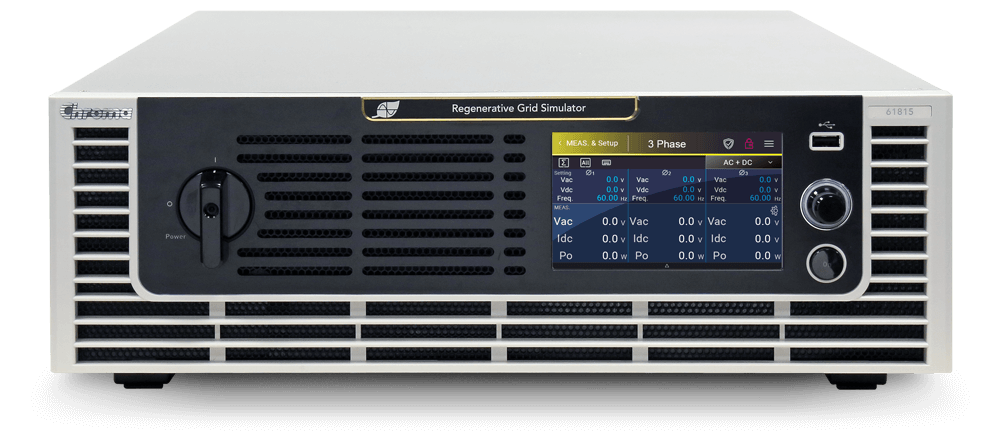
61800 Series Grid Simulator
- Power Range: 9kVA to 105kVA (Parallelable to 840kVA)
- Voltage Output: 0-300V / 0-500V L-N
- Frequency Range: DC, 30Hz - 100Hz
- Energy Recovery: > 88% - 92%
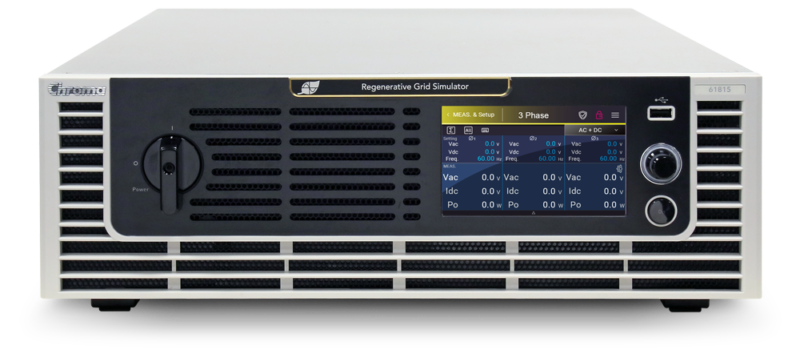
High-Power 4-Quadrant Systems
- Power Range: Up to MW scale custom cabinets
- Harmonic Synthesis: 50/60Hz base + synthesized harmonics
- Modes: AC, DC, AC+DC, 3-Phase Unbalanced
- Compliance Testing: IEEE 1547, UL 1741, IEC 61000
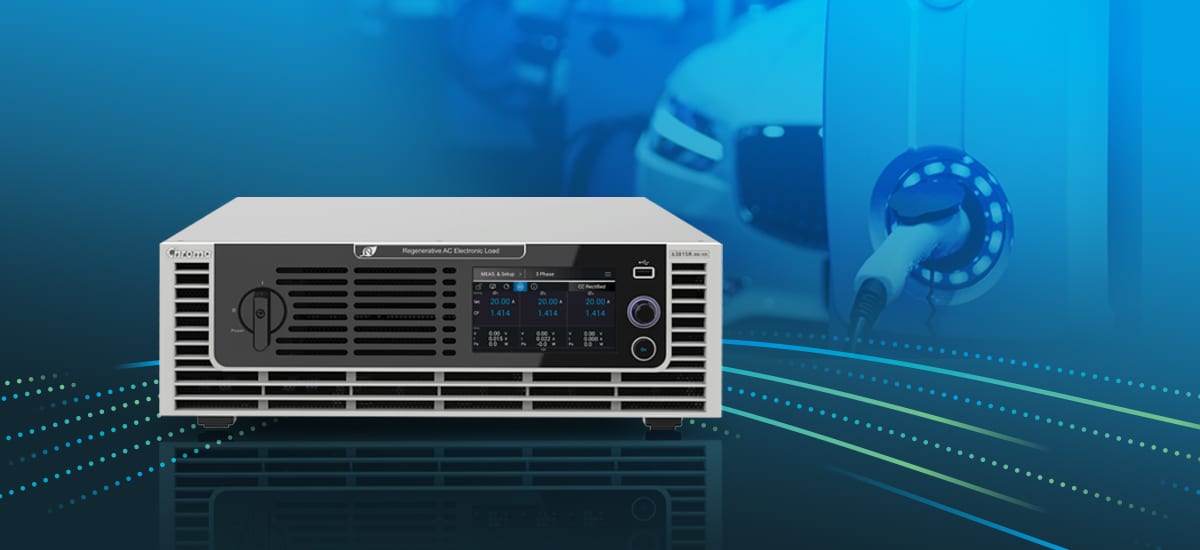
63800R Regenerative AC Load
- Power Range: 9kVA to 15kVA per unit
- Functions: AC/DC Load simulation + Regen back to grid
- Energy Savings: Up to 89% thermal power savings
- Applications: BOBC, V2L, V2H, ESS Testing
4. Technical Matrix: Standard AC Source vs. 4-Quadrant Regenerative Grid Simulator
Understanding the distinction between traditional power generation instruments and full 4-quadrant grid simulation is vital when establishing budget priorities for high-power laboratories:
| Performance Parameter | Standard AC Power Source | Regenerative AC Grid Simulator |
|---|---|---|
| Operating Quadrants | 2-Quadrant (Sourcing Only) | 4-Quadrant (Full Sourcing & Sinking) |
| Reverse Power Recovery Efficiency | 0% (Requires dissipative load banks) | 88% to > 92% back to facility grid |
| Transient Programming (LVRT/HVRT) | Limited / Slow Slew Rates | Sub-millisecond step response & voltage sags |
| Harmonic & Inter-harmonic Injection | Basic THD generation | Independent phase-harmonic synthesis up to 50th order |
| Grid Standards Automated Software | Manual step testing required | Pre-programmed suites (IEEE 1547.1, UL 1741, IEC 61000-4) |
| Thermal & HVAC Load Impact | Very High (100% power converted to heat) | Extremely Low (~8-12% heat dissipation) |
5. Frequently Asked Questions (FAQ) for Global Buyers
Answers to key technical questions submitted by engineering leads and global procurement directors during technical due diligence:
In AC power systems, 4-quadrant operation refers to the capability of an instrument to operate in all four combinations of AC voltage and AC current phase angles:
- Quadrant I: Positive Voltage, Positive Current (Sourcing power with inductive/capacitive phase lead).
- Quadrant II: Positive Voltage, Negative Current (Absorbing/Sinking reverse current from a generating DUT).
- Quadrant III: Negative Voltage, Negative Current (Reverse voltage sourcing).
- Quadrant IV: Negative Voltage, Positive Current (Absorbing power during negative half-cycles).
This allows the simulator to act simultaneously as a programmable utility power source and a dynamic energy-recovering AC load.
Chroma’s regenerative grid simulators utilize advanced active front-end (AFE) power factor corrected (PFC) inverter stages. When energy flows from the DUT back into the simulator, the internal DSP synchronizes the feedback current to match the facility's incoming line frequency and voltage with low total harmonic distortion (THD < 3%). This ensures the energy fed back is clean, meeting IEEE 519 standards without disturbing neighboring laboratory equipment or causing line-voltage bounce.
The ROI consists of two main cost reductions: direct electricity savings and HVAC cooling savings. For example, testing a 100kW grid-tied inverter continuously over two shifts (4,000 hours/year) at an average energy rate of $0.15/kWh:
- Direct Electricity Recovery (90% Efficiency): 100kW × 90% × 4,000h = 360,000 kWh saved ($54,000 annually).
- HVAC Cooling Reduction: Removing 90kW of waste heat saves approximately 25 tons of chiller capacity (~$15,000 annually in cooling power).
Combined annual savings often exceed $69,000 per 100kW unit, yielding full capital equipment payback in 14 to 22 months depending on local utility tariffs.
Yes. Chroma grid simulators feature fast DSP-controlled transient execution capable of outputting step changes in voltage and frequency within less than 2 milliseconds. They include arbitrary waveform generation for synthesizing voltage sags, swells, interruption profiles, phase angle jumps, and complex harmonic distortion required for IEEE 1547.1 anti-islanding and grid fault ride-through validation.
Chroma offers specialized SoftPanel automation suites configured with pre-written test routines for IEEE 1547.1, UL 1741 SB, and IEC 61000 standards. Engineers can execute complete regulatory test sequences with a single click, automatically generating pass/fail reports, waveform logs, and data points, reducing compliance testing cycles from weeks to hours.
6. Enterprise Advantages & Engineering Authority (E-E-A-T)
Selecting Chroma Systems Solutions means partnering with an industry pioneer in automated power test equipment. Our commitment to accuracy, safety, and operational longevity is validated by decades of leadership:
Why World-Class Engineering Labs Rely on Chroma
40+ Years of Power Electronics Innovation
Over four decades of dedicated engineering experience in programmable power supplies, electronic loads, and automated test systems worldwide.
Up to 92% Energy Efficiency Recovery
Industry-leading active front-end technology minimizes lab carbon footprint, lowers thermal overhead, and drastically cuts operating expenditure.
100kW+ Modular & Parallel Scale
Flexible master-slave architecture allows seamlessly scaling power capability from 9kVA benchtop configurations up to Megawatt-class test systems.
Global Support & ISO 17025 Accreditation
Worldwide calibration centers, application engineering support, and rapid field service throughout North America, Europe, and Asia-Pacific.
Request Technical Specifications or a Custom Quote
Connect directly with our application engineers to analyze your grid simulation parameters, design automated test profiles, or evaluate ROI savings for your lab setup.