
Precision Component & Complex Impedance Measurement
Chroma programmable LCR meters deliver high-precision impedance validation across a wide spectrum of electronic components. Engineered for modern R&D laboratories, quality assurance (QA), incoming material inspection, and high-speed automated test equipment (ATE) environments, Chroma LCR meters combine laboratory-grade accuracy with ultra-fast measurement speeds.
From fundamental component characterization to advanced high-frequency RF testing, our instrumentation evaluates capacitors, inductors, resistors, transformers, filters, and semiconductor materials with programmable stimulus levels and automated parameter monitoring.
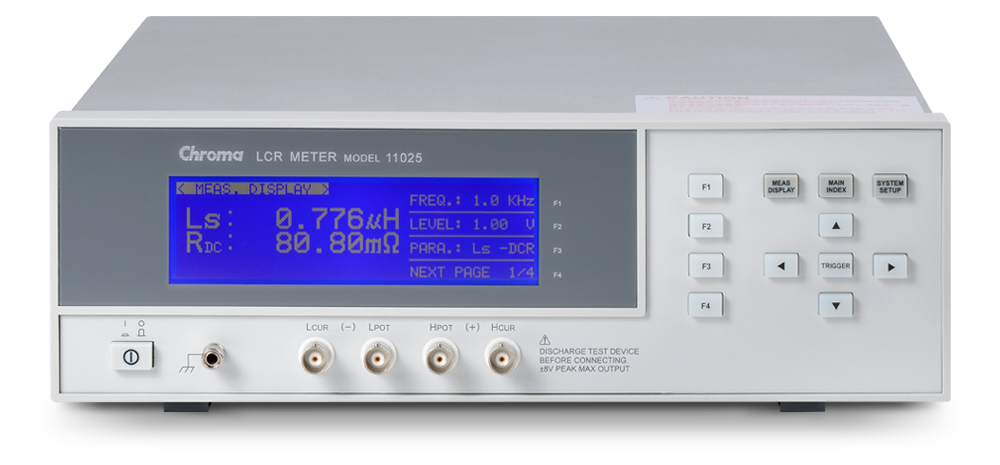
Understanding LCR Measurement Principles
An LCR meter is a specialized electronic instrument designed to evaluate complex impedance parameters under AC test signals. Unlike basic DC multimeters, an LCR meter subjects the device under test (DUT) to selectable frequencies and voltage levels, precisely analyzing phase angle and current-voltage relationships.
Primary Parameters (L, C, R)
Measures fundamental electrical parameters including Inductance (L), Capacitance (C), and Resistance (R) under controlled AC drive conditions.
Impedance & Reactance (Z, X)
Calculates total complex Impedance magnitude (Z), phase angle (θ), and Reactance (X) to determine component behavior in dynamic circuits.
Quality & Loss (Q, D, ESR)
Evaluates efficiency characteristics, measuring Dissipation Factor (D), Quality Factor (Q), and Equivalent Series Resistance (ESR) for power loss analysis.
Admittance & Conductance (Y, G, B)
Derives Y-matrix parameters including Admittance (Y), Conductance (G), and Susceptance (B) required for advanced network analysis.
Chroma LCR Meter Product Selection Matrix
Selecting the optimal LCR meter requires evaluating required test frequency, stimulus voltage, basic measurement accuracy, speed, and automation interfaces. Use the comparative matrix below to find the exact instrument tailored to your engineering specifications.
| Model Series | Frequency Range | Test Signal Level | Basic Accuracy | Speed | Primary Target Applications |
|---|---|---|---|---|---|
|
General Purpose
11021 / 11021-L
|
100 Hz – 50 kHz | 11021: 0.25V / 1.0V 11021-L: 50mV / 1.0V |
0.1% / 0.2% | 75 ms | Benchtop evaluation, component sorting, QA inspection, and production lines. |
|
High Precision
11022 / 11025
|
50 Hz – 100 kHz | 10 mV – 1 V (10mV steps) | 0.1% | 21 ms | Precision R&D component characterization, automated ATE systems, and quality control. |
|
High Frequency
11050 Series
|
60 Hz – 30 MHz | 10 mV – 5 V | 0.1% | 15 ms | High-frequency magnetic components, power inductors, switching circuit capacitors, and HF material analysis. |
|
RF Testing
11090-030 RF
|
100 kHz – 300 MHz | -40 dBm – 1 dBm | High-Precision RF | 0.5 ms | SMD chip inductors, RF filters, telecom passives, high-speed automated sorting. |
|
Capacitor Leakage
11200 Series
|
DC IR / Leakage Current | 1 V – 100 V DC (0.1V steps) | 0.3% | 77 ms | Capacitor insulation resistance (IR) and leakage current verification for production & QA. |
Impedance & LCR Measurement Primer
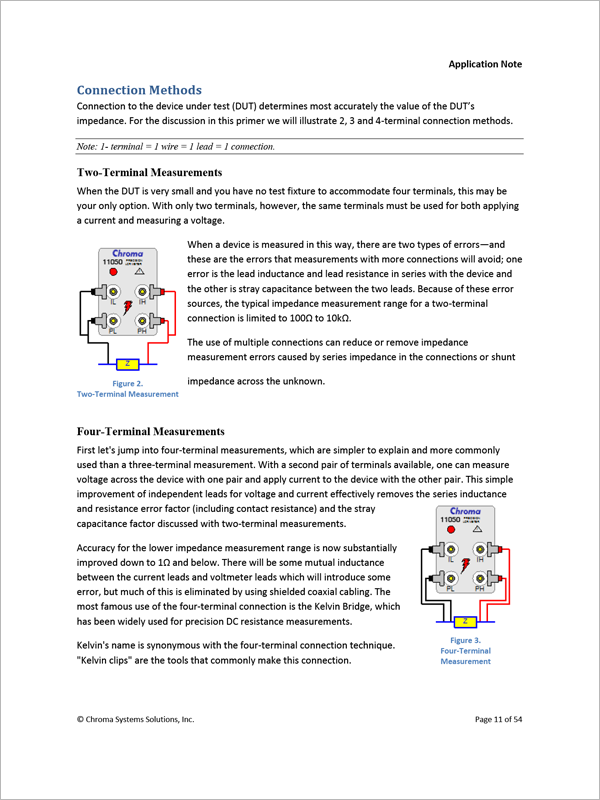
Understanding complex impedance is vital for circuit design reliability. This comprehensive technical guide defines impedance parameter equations (L, C, R, Z, ESR, Q, D), measurement error compensation techniques (Open/Short calibration), and signal drive level considerations across varying operating conditions.
Frequently Asked Questions
Expert answers to critical technical questions regarding LCR meter operation, frequency selection, and component testing accuracy.
What parameters does an LCR meter measure?
An LCR meter measures inductance (L), capacitance (C), and resistance (R), as well as complex impedance (Z), reactance (X), conductance (G), susceptance (B), quality factor (Q), dissipation factor (D), phase angle (θ), and equivalent series resistance (ESR).
How does an LCR meter differ from a digital multimeter?
A standard digital multimeter (DMM) typically measures static DC properties like DC voltage, current, and resistance. An LCR meter injects an AC excitation signal at controlled, programmable frequencies to evaluate frequency-dependent AC impedance and phase shifts.
Why is test frequency critical in LCR measurement?
Passive electronic components exhibit frequency-dependent characteristics. Parasitic capacitance, self-inductance, and ESR vary across the frequency spectrum. Testing at the component's intended operating frequency provides accurate measurement relevant to real-world circuit performance.
Can Chroma LCR meters measure Equivalent Series Resistance (ESR)?
Yes. Chroma LCR meters provide direct ESR measurement capabilities. Evaluating ESR is critical for determining energy loss, heating, and filtering efficiency in capacitors and power inductors installed in switching power supplies.
How do I select the proper test frequency for my components?
For general passives, standard commercial test frequencies include 100 Hz, 1 kHz, 10 kHz, and 100 kHz. Switching power supply components are typically evaluated from 100 kHz up to 30 MHz, while RF devices, telecom filters, and chip inductors require test frequencies up to 300 MHz.
What defines a High-Frequency or RF LCR Meter?
High-frequency and RF LCR meters test components into the megahertz spectrum (up to 300 MHz). They incorporate high-frequency fixture designs, precise RF signal sources, and high-speed sampling to measure surface-mount chip inductors, RF transformers, and high-frequency capacitors.
Need Assistance Selecting the Right LCR Test Equipment?
Consult with Chroma's application engineers to determine the exact model, test fixtures, and automation options for your production validation or R&D requirements.