
Regenerative AC Electronic Load Solutions: High-Efficiency Power Testing & Grid Feedback
Transform heavy electrical load testing into clean energy recovery. Chroma's advanced Regenerative AC Electronic Load technology offers up to 89% energy efficiency, precise non-linear waveform loading, dynamic crest factor synthesis, and scalable power up to 150kVA for EVSE, V2X, UPS, and microgrid validation.
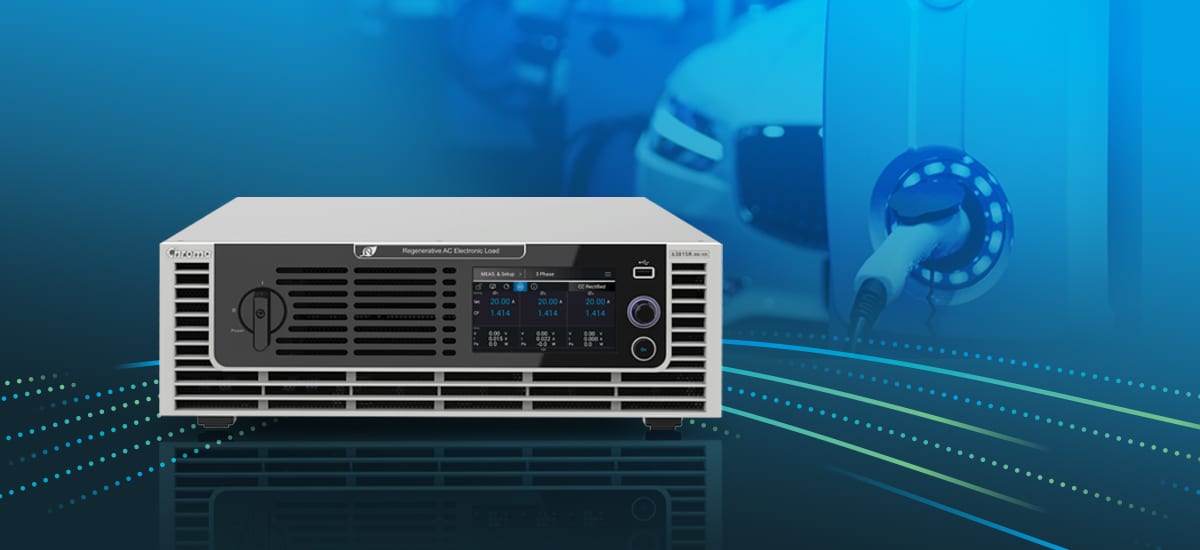
Redefining Power Test Facilities with Energy-Recycling Load Emulation
As power electronics transition toward higher voltage ratings, bidirectional energy flow, and carbon-neutral facility requirements, standard legacy resistive loads are no longer economically or environmentally viable. Chroma’s Regenerative AC Electronic Load architectures convert power consumed during test cycles into high-quality grid-synchronized AC electricity—recycling up to 89% back to the facility mains.
Chroma 63800R Series Regenerative AC Electronic Load
Designed specifically for R&D validation and automated mass-production testing, the Chroma 63800R Series delivers unprecedented energy recovery capability alongside sophisticated AC load simulation modes.
| Model Designation | Power Capacity (kVA) | Voltage Range (Vrms) | Current Range (Arms) | Frequency Range (Hz) | Energy Recovery |
|---|---|---|---|---|---|
| 63800R-9K | 9 kVA | 50V to 350V rms | Up to 90A rms | 45Hz – 400Hz | Up to 89% Efficiency |
| 63800R-12K | 12 kVA | 50V to 350V rms | Up to 120A rms | 45Hz – 400Hz | Up to 89% Efficiency |
| 63800R-15K | 15 kVA (3U) | 50V to 350V rms | Up to 150A rms | 45Hz – 400Hz | Up to 89% Efficiency |
| 63800R Parallel System | Up to 150 kVA | 50V to 350V rms (Line-Neutral) | Up to 1500A rms | 45Hz – 400Hz | Up to 89% Efficiency |
Advanced Operating Modes
Supports Constant Current (CC), Constant Resistance (CR), Constant Power (CP), Rectified Load Mode, RL Load Mode, and dynamic pulse loading for real-world equipment evaluation.
DSP Waveform Synthesizer
Equipped with high-resolution Digital Signal Processing to synthesize non-linear load currents, phase-shifted currents, and harmonic wave distortions up to the 50th order.
Massive OPEX & HVAC Savings
By returning power directly back to facility AC mains rather than expelling heat, test labs lower utility costs and significantly downsize facility HVAC cooling infrastructure.
Global Procurement Trends in AC Load Testing Equipment
Global procurement executives, lab directors, and test system integrators face escalating pressure to balance operational throughput, strict accuracy standards, and ambitious ESG (Environmental, Social, and Governance) targets. When sourcing high-power test hardware, modern procurement criteria have fundamentally expanded from basic hardware specifications to long-term lifecycle metrics.
1. The Transition from Capex-Only to Total Cost of Ownership (TCO)
Historically, load procurement focused primarily on initial purchase price (CAPEX). However, running traditional dissipative AC loads—such as massive resistive banks—in 24/7 reliability test environments consumes millions of kilowatt-hours per year while generating extreme thermal output. Test facilities now mandate Total Cost of Ownership calculations. Buying a Regenerative AC Electronic Load like the Chroma 63800R typically yields a payback period of under 18 to 24 months solely based on reduced power draw and facility HVAC utility offset.
2. Explosion in V2G, V2L, and Vehicle-to-Everything (V2X) Validation
Automotive OEMs and Tier-1 suppliers are standardizing bidirectional power capability across Electric Vehicle (EV) platforms. Onboard Chargers (OBC) and Bidirectional EV Chargers (EVSE) must feed power seamlessly into domestic appliances (Vehicle-to-Load) and back into the electrical grid (Vehicle-to-Grid). Consequently, testing requirements demand a load system that can act seamlessly as a phase-synchronized, dynamic AC load to validate bidirectional power conversion under diverse grid conditions.
3. Modular Parallelization and Compact Rack Footprint
Floor space inside modern R&D and manufacturing facilities commands a premium. Enterprise buyers prioritize 3U high-power-density form factors capable of multi-unit master-slave parallel operation. Procurement teams seek modular solutions that allow lab expansion from 15kVA to 150kVA without custom mechanical retrofits or redundant safety sub-panels.
4. Compliance with Strict International Grid Interconnection Standards
As renewable microgrids, energy storage inverters, and uninterruptible power supplies (UPS) scale globally, regulatory compliance (including IEEE 1547, UL 1741 SB, EN 50549, and IEC 62116) requires test equipment with stringent anti-islanding protection, fast transient voltage response, and high immunity to mains harmonics during grid feedback operation.
Future Engineering & Technology Trends for AC Loads
The rapid evolution of semiconductor physics, digital control algorithms, and smart grid architectures is accelerating technological innovations in regenerative power instruments:
SiC & GaN Power Switches
Integration of Wide Bandgap (WBG) semiconductors like Silicon Carbide (SiC) enables switching frequencies exceeding 100kHz, reducing passive component sizes, lowering internal switching losses, and increasing overall power density.
AI & Predictive Dynamic Loading
Next-generation electronic loads are incorporating machine learning to autonomously replay real-world grid distrubances, dynamic EV loading stress profiles, and unpredictable fault conditions with millisecond timing precision.
Ultra-Low Latency HIL Integration
Direct digital optical interfaces (e.g., EtherCAT, Aurora) allow regenerative loads to interface directly with Hardware-in-the-Loop (HIL) real-time simulators for high-fidelity digital twin power emulation.
Unrivaled E-E-A-T: Over 40 Years of Power Test Innovation
Chroma Systems Solutions stands as the premier global manufacturer of precision power testing instruments and automated test systems. Our engineering design principles guarantee absolute measurement reliability, safety, and compliance.
- Proven Market Leadership: Trusted by world-leading aerospace, EV, battery, server, and solar manufacturers.
- Global Service Infrastructure: Dedicated calibration, technical support, and rapid repair centers across the Americas, Europe, and Asia.
- Turnkey Software Automation: Seamless integration with Chroma PowerPro automation suite and industry-standard SCPI communication protocols.
- Strict Safety & Grid Protection: Built-in over-voltage, over-current, over-power, over-temperature, and anti-islanding isolation features.
Frequently Asked Questions: Regenerative AC Electronic Loads
Key technical insights to assist procurement managers and power engineers in evaluating regenerative AC load technology.
A conventional resistive AC load converts consumed electrical energy directly into thermal heat using resistive heating elements, requiring heavy fan cooling and wasting 100% of the tested energy. A Regenerative AC Electronic Load (such as the Chroma 63800R) acts as an active power converter. It sink AC power from the Device Under Test (DUT), synchronizes with the facility's local AC mains voltage and frequency, and returns up to 89% or more of that consumed energy back into the building grid. This drastically cuts utility power bills and minimizes facility cooling infrastructure requirements.
The economic payback of a regenerative system operates on two fronts: Direct Electricity Recycling and HVAC Reduction. For example, testing a 15kVA system continuously using a traditional load dissipates 15kW of continuous heat. Air conditioning systems require approximately 1kW of cooling power for every 3kW of heat dissipated. By using a Chroma Regenerative load with 89% efficiency, you save ~13.35kW of consumed power plus ~4.45kW of HVAC cooling power. Over 8,000 annual operating hours, this saves over 140,000 kWh of energy per year per unit.
Yes. Traditional AC loads struggle to accurately simulate non-linear loads like rectifiers, switched-mode power supplies (SMPS), or variable frequency drives. The Chroma 63800R features a programmable Crest Factor range from 1.414 up to 5.0. Its onboard digital signal processor (DSP) enables engineers to simulate distorted current waveforms, phase-shifted inductive/capacitive loads (RLC mode), and transient inrush currents without sacrificing energy feedback efficiency.
Chroma regenerative loads incorporate multi-layered grid protection architectures. The unit constantly monitors grid voltage amplitude, phase angle, and frequency stability. In the event of a facility brownout, blackout, over-voltage, or islanding condition, the internal high-speed DSP cuts off power feedback in less than milliseconds (conforming to international anti-islanding standards like IEEE 1547 and UL 1741). Comprehensive hardware over-current (OCP), over-voltage (OVP), over-power (OPP), and over-temperature (OTP) protection circuits are also integrated.
During V2L or V2G testing, an Electric Vehicle's onboard charger (OBC) or external bidirectional DC-to-AC inverter outputs AC electrical power. To validate the EV's output stability under real-world conditions, a test load must sink AC power under varying power factors, harmonic profiles, and transient steps. The 63800R simulates home appliances or grid loads while consuming the EV's discharged energy and feeding it back into the test lab grid cleanly, enabling continuous endurance cycling without battery discharge waste.
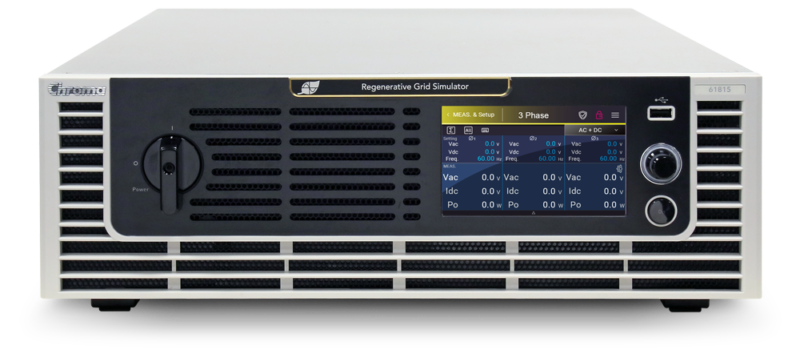
While both instruments feature grid recycling capability, an AC Grid Simulator acts primarily as an active AC voltage source to power grid-tied devices (such as PV inverters or grid-tied energy storage systems) and simulate voltage sags, frequency fluctuations, and grid faults. A Regenerative AC Electronic Load acts as a controlled current sink (load) designed to evaluate power generators, UPS systems, EVSE chargers, and inverters by loading their output according to programmed electrical current profile commands.
Absolutely. Chroma provides full software suite support, including standard SCPI command sets, LabVIEW drivers, Python APIs, and Chroma's flagship PowerPro automated test system software. This allows engineering teams to easily integrate the 63800R into fully automated design validation (DVT) and production test racks.