
1. Executive Summary & Semantic Industry Overview
The electric vehicle (EV) global market is transitioning rapidly from standard 400V battery architectures to 800V ultra-fast charging platforms, driven by the demand for shorter charging times and lighter vehicle weight. At the heart of this electric powertrain transformation are two critical power conversion units: the On-Board Charger (OBC) and the High-Voltage to Low-Voltage DC-DC Converter (HV-LV DC-DC).
Modern EV powertrains are consolidated into multi-in-one integrated power assemblies (Combo units, 2-in-1, 3-in-1, or up to 8-in-1 e-axle assemblies). Validating these complex units requires an EV OBC DC-DC Converter Automated Test System (ATE) capable of simultaneous multi-channel power injection, bi-directional energy flow testing, real-time CAN/CAN-FD communication logging, and electrical safety verification under extreme thermal and voltage stress.
Traditional, siloed benchtop test setups introduce unacceptably high test cycle times, voltage drop errors, safety risks for engineers, and excessive thermal loss in production lines. Modern ATE architectures integrate Regenerative Grid Simulators and Bidirectional DC Sources, enabling test labs to recycle up to 92% of drawn test energy back to the local utility grid—slashing operational costs while increasing throughput by over 300%.
2. Recommended ATE Architecture & Hardware Instruments
An enterprise-grade EV OBC DC-DC Converter Automated Test System requires a modular, open-architecture instrumentation rack engineered for precision, high bandwidth, and continuous heavy-duty cycle operations in design validation (DVT) and mass production (PVT).
Figure 1: Chroma Integrated EV Power Test Rack Configuration featuring Bidirectional Sources & Power HIL Control.
Core Hardware Component Specifications
To achieve high accuracy and strict compliance with global OEM standard operating procedures, Chroma recommends integrating the following precision instruments within the ATE cabinet:
| System Module | Recommended Model / Hardware | Key Operational Capabilities |
|---|---|---|
| Regenerative Grid Simulator | Chroma 61800 Series | Simulates global AC grid conditions (single-phase & 3-phase, 0-500Vac, 15-90Hz), sub-harmonic distortion, phase angle dropouts, and recycles load energy back to the grid at >90% efficiency. |
| Bidirectional DC Power Supply | Chroma 62000D Series | High-power density (up to 18kW in 3U), dual-quadrant operation (seamless transition between source and sink mode), auto-ranging voltage up to 2000V for 800V battery simulation. |
| Regenerative AC/DC Electronic Load | Chroma 63800R / 63200A Series | Simulates low-voltage 12V/24V/48V auxiliary loads or high-power battery dynamic loading profiles with programmable crest factor and transient surge simulation. |
| Multi-Channel Digital Power Meter | Chroma 66200 Series | Precise efficiency calculations (up to 99.9% accuracy), total harmonic distortion (THD) measurement, and high-frequency power switching analysis up to 500kHz. |
| Integrated Hipot & Safety Tester | Chroma 19032 / 19036 Series | Automated AC/DC Withstand Voltage, Insulation Resistance (IR), and Ground Bond (GB) testing with multi-channel scanner integration for automotive safety compliance. |
By combining these instruments into a unified ATE frame governed by Chroma PowerPro III Test Automation Software, test engineers eliminate manual cable switching, guarantee sub-millisecond data synchronization, and fully automate complex test sequences.
Need a Customized EV Power Test Architecture?
Speak directly with our senior power electronics engineers to configure a turnkey EV OBC & DC-DC Converter Test Solution tailored to your OEM engineering specs.
Contact Us3. Emerging Technology Trends in EV OBC & DC-DC Testing
The rapidly advancing EV power landscape demands that test equipment keep pace with next-generation semiconductor physics, bidirectional energy networks, and real-time Hardware-in-the-Loop (HIL) vehicle simulation. Sourcing managers must evaluate test systems based on their readiness for these four pivotal technology trends:
Trend A: Wide Bandgap (SiC & GaN) Semiconductor Dynamic Testing
Silicon Carbide (SiC) MOSFETs and Gallium Nitride (GaN) HEMTs are replacing traditional Silicon IGBTs in 800V OBCs due to their higher breakdown voltage, faster switching frequencies (exceeding 100kHz-500kHz), and superior thermal performance. However, high dV/dt and dI/dt switching transients introduce severe Electromagnetic Interference (EMI), voltage ringing, and high-frequency noise.
Modern ATE systems must feature extremely low stray inductance cabling, ultra-fast sampling oscilloscopes, and high-bandwidth isolated probe interfaces to measure transient voltage overshoots, turn-on/turn-off timing, and switching loss accurately without distorting the DUT (Device Under Test) operational state.
Trend B: Bidirectional Power Flow (V2L, V2G, V2H) Validation
On-Board Chargers are no longer static unidirectional AC-to-DC energy converters. Next-generation EVs serve as mobile energy storage systems capable of supplying power back to external loads (Vehicle-to-Load / V2L), residential homes (Vehicle-to-Home / V2H), or utility power grids (Vehicle-to-Grid / V2G).
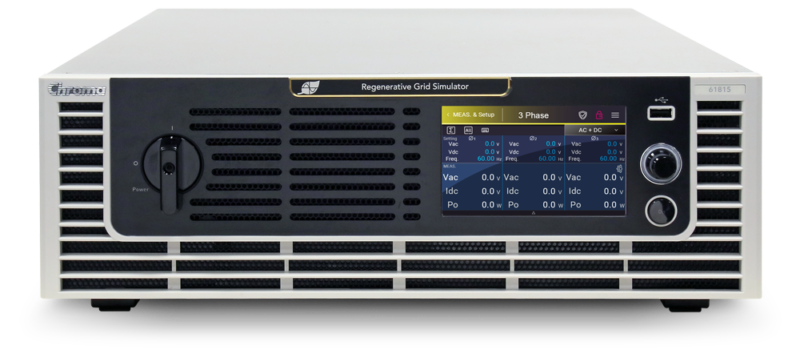
Figure 2: Chroma Dual-Quadrant Bidirectional DC Power Source supporting instant V2G direction switching.
This bi-directional functionality requires test equipment capable of continuous microsecond quadrant-switching. The Chroma EV ATE seamlessly shifts between acting as an AC grid source / DC battery load during G2V (Grid-to-Vehicle) charging mode, and an AC regenerative load / DC power source during V2G discharging mode, validating islanding protection, reverse power efficiency, and grid-synchronization response time.
Trend C: Power Hardware-in-the-Loop (P-HIL) Integration
Traditional functional testing relies on static voltage and current inputs. However, real-world EV operation involves extreme dynamic transients—such as sudden regenerative braking, rapid throttle acceleration, AC line dropouts, and fluctuating fast-charging profiles.
By coupling the EV OBC DC-DC Converter ATE with a real-time simulator (e.g., Opal-RT, dSPACE, or Typhoon HIL), engineers achieve true Power Hardware-in-the-Loop (P-HIL) validation. The ATE receives dynamic control signals over CAN/EtherCAT, physically stressing the OBC power stage while simulating full vehicle vehicle-level firmware interaction under virtual fault injections.
Trend D: Green Manufacturing & Energy Regeneration
During 24/7 burn-in and endurance testing of high-power 22kW OBCs and 3kW DC-DC converters, conventional resistive electronic loads dissipate tens of thousands of kilowatt-hours as waste heat, requiring industrial-scale chillers and HVAC equipment.
Chroma's proprietary Regenerative Power Technology captures the energy discharged by the DUT and converts it back into clean AC electrical power synchronized with the facility’s utility line at up to 92% efficiency. This drastically cuts facility electricity bills, reduces carbon footprint, and eliminates excess thermal stress in production environments.
4. Global Sourcing Trends & Procurement Sourcing Checklist
When global automotive OEMs and Tier-1 suppliers contract manufacturing lines across North America, Europe, and Asia-Pacific, procurement officers must balance initial capital expenditure (CAPEX) against long-term operational efficiency (OPEX) and global safety standardization.
Engineering Expertise & Compliance Assurance
Chroma's EV test systems are built to meet rigorous global standards including ISO 26262 (Functional Safety), IEC 61851-1, SAE J1772, GB/T 18487, ISO/IEC 15118 (Plug & Charge), and CISPR 25 EMC compliance standards.
Procurement Evaluation Checklist for Engineering & Sourcing Managers:
- Voltage & Power Scalability: Does the system architecture support current 400V bus standards while offering seamless expansion to 800V and 1200V high-voltage platforms via modular power stacking?
- Total Efficiency & TCO: What is the energy recovery efficiency of the DC loads and AC grid simulators? (Higher efficiency direct savings translate to full ROI within 14-18 months of continuous mass production burn-in testing).
- Software Agility & Open APIs: Does the system support standardized lab control protocols (LabVIEW, Python, C++, SCPI, CANoe, Vector) for automated report generation and MES database integration?
- Global Calibration & Support Footprint: Does the vendor maintain local ISO 17025 accredited calibration labs and field application engineering support across North America, Europe, and Asian manufacturing hubs?
- Safety Interlock Architecture: Does the ATE feature hardware-level Emergency Power Off (EPO), dual-channel safety relays, insulation monitoring, and high-voltage enclosure interlocks to guarantee operator safety?
5. Chroma Enterprise Strengths & Global E-E-A-T Leadership
With over 40 years of power conversion test leadership, Chroma Systems Solutions is the globally recognized standard in automated test equipment. Our commitment to high-precision instrumentation, engineering innovation, and customer reliability makes Chroma the trusted supplier for top electric vehicle OEMs, Tier-1 automotive power electronics vendors, and certified compliance testing laboratories worldwide.
Global Service Network
Direct technical service centers, spare parts inventory, and accredited calibration teams located across the US, Europe, Taiwan, China, Japan, and Southeast Asia.
Turnkey Software Platform
PowerPro III software offers built-in standardized EV test item libraries, eliminating hundreds of hours of custom scripting and accelerating time-to-market.
6. Frequently Asked Questions (Global Procurement & Technical Intent)
7. Accelerate Your EV Power Electronics Validation Today
Whether you are scaling an R&D laboratory to validate next-generation 800V SiC bidirectional OBCs or commissioning high-volume end-of-line production lines for automotive power converters, Chroma Systems Solutions delivers unmatched precision, safety, and energy efficiency.
Contact our senior EV power application team today to request a technical consultation, system demonstration, or detailed budgetary quotation.
Talk with an EV Test Solutions Specialist
Our application engineers are standing by to review your DUT specifications and configure the optimal EV OBC DC-DC Converter Automated Test System for your lab.