4. Global Procurement Trends & Financial TCO / ROI Analysis
Evaluating the economic advantages of replacing conventional power equipment with high-efficiency bidirectional DC power supplies.
Global procurement teams in aerospace, automotive OEM, battery cell manufacturing, and hyperscale data centers are moving away from evaluating power supplies purely on initial purchase price (CAPEX). Instead, modern engineering procurement focuses on Total Cost of Ownership (TCO), ESG decarbonization goals, and lab flexibility.
The Economic Formula for Energy Regeneration Savings
Consider a typical 100kW test rack operating 16 hours a day, 250 days a year (4,000 operational hours/year) in a battery cycling or EV charger burn-in lab:
Financial Comparison Model: Conventional vs. Chroma Bidirectional Supply
- Total Annual Energy Consumed by DUT/Test Load: 100 kW × 4,000 hrs = 400,000 kWh / year.
- Conventional Load Cost: 400,000 kWh × $0.18/kWh (industrial rate) = $72,000 / year in wasted electricity.
- Additional HVAC Thermal Removal Cost: Heat generated requires ~0.33 kW of AC cooling per kW dissipated = 132,000 kWh additional cooling power × $0.18/kWh = $23,760 / year in HVAC costs.
- Total Conventional OPEX: $95,760 per year.
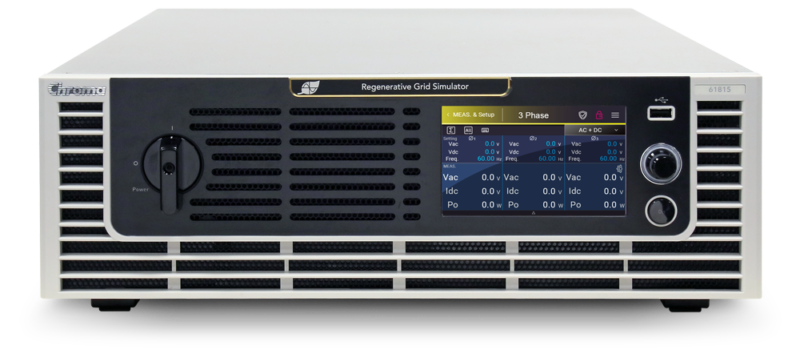
- Chroma 93% Regenerative System OPEX: Recovers $66,960 in electricity directly to grid and eliminates 93% of HVAC cooling load ($22,096 savings) = Annual Savings of $89,056 per 100kW test rack.
Payback Period Result: Sourcing a bidirectional regenerative DC power supply amortizes its capital expenditure premium in under 12 to 14 months, while simultaneously reducing facility CO2 footprint by over 180 metric tons annually per rack.