
Next-Gen Partial Discharge Tester: The Definitive Global Sourcing & Technical Selection Guide for High-Voltage Reliability
Evaluate ultra-low noise Partial Discharge (PD) measurement systems, phase-resolved diagnostics (PRPD), high-frequency current transformers (HFCT), TEV sensors, and integrated impulse withstand testers engineered for zero-defect power electronics, EV traction motors, and high-voltage grid assets.
Understanding Partial Discharge (PD): Physics, Risk Mitigation, and Quality Assurance
In modern electrical engineering, insulation failure accounts for over 85% of catastrophic high-voltage component breakdowns across power distribution grids, electric vehicle (EV) powertrains, industrial motor drives, and renewable energy substations. A Partial Discharge Tester is the ultimate diagnostic weapon against unexpected insulation breakdown. Partial discharge refers to a localized electrical discharge that only partially bridges the insulation between conductors, occurring within microscopic internal voids, cracks, surface contaminants, or gas bubbles embedded in solid, liquid, or gas insulation systems.
Unlike full dielectric breakdown (flashover or arc-over), partial discharge does not immediately shut down electrical operation. Instead, PD exerts continuous electrical, thermal, chemical, and mechanical stress on the surrounding dielectric material. Over time, recurring discharge events produce ozone, nitrous acids, and carbonized conductive micro-tracks—a phenomenon known as electrical treeing. This progressive degradation inevitably escalates into total dielectric breakdown, leading to costly un-planned outages, equipment destruction, fire hazards, and severe safety risks.
Why Partial Discharge Testing is Mandatory Across Modern Supply Chains
The accelerating adoption of wide-bandgap (WBG) semiconductors—such as Silicon Carbide (SiC) MOSFETs and Gallium Nitride (GaN) HEMTs—in electric vehicle drive inverters and AI server high-density power supplies has significantly elevated voltage stress ($\frac{dv}{dt}$). Fast pulse rise times (often exceeding 50 to 100 kV/µs) subject motor stator windings, magnet wires, and isolation transformers to extreme repetitive surge voltages. This steep voltage transient triggers partial discharge at much lower voltage thresholds than conventional 50/60 Hz sine-wave excitations.
Implementing routine factory testing and laboratory R&D screening using a high-precision Partial Discharge Tester ensures that component manufacturers and system integrators comply with strict international insulation standards including:
- IEC 60270: High-voltage test techniques – Partial discharge measurements.
- IEC 60664-1 & IEC 60664-4: Insulation coordination for equipment within low-voltage systems under high-frequency voltage stress.
- IEC 60034-18-41 / 42: Qualification and type tests for partial discharge free electrical insulation systems in rotating machines driven by voltage converters.
- IEEE 400.3: Guide for Partial Discharge Testing of Shielded Power Cable Systems.
Recommended Partial Discharge Testers & Insulation Validation Portfolio
Selecting the optimal Partial Discharge Tester depends heavily on your specific device under test (DUT), testing environment (factory floor vs. R&D lab vs. field substation), and regulatory target. Chroma Systems Solutions engineered a comprehensive range of electrical safety, surge withstand, and partial discharge analyzers designed for demanding engineering teams.
Precision Partial Discharge & Hipot Tester Series
R&D & Production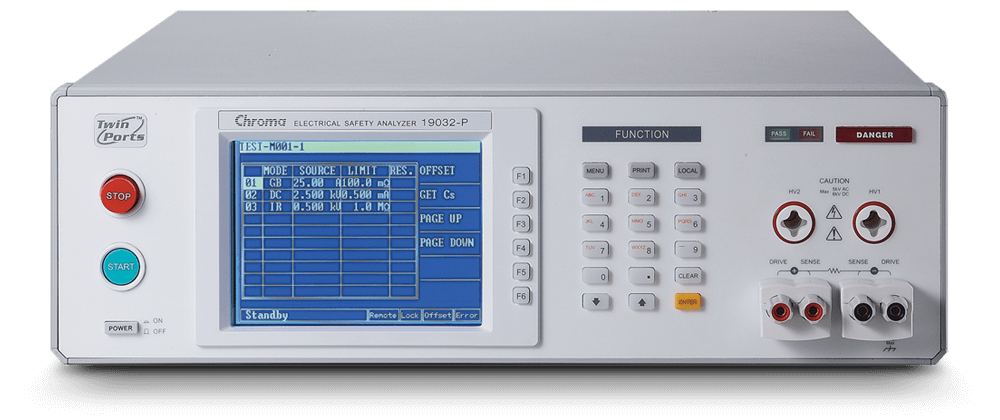
Combines programmable AC/DC Hipot safety withstand testing with high-sensitivity Partial Discharge analysis ($<1\text{ pC}$). Features phase-resolved partial discharge (PRPD) imaging, programmable voltage ramps, and automated pass/fail detection.
Automated Impulse Surge & PD Winding Tester
EV Motors & Coils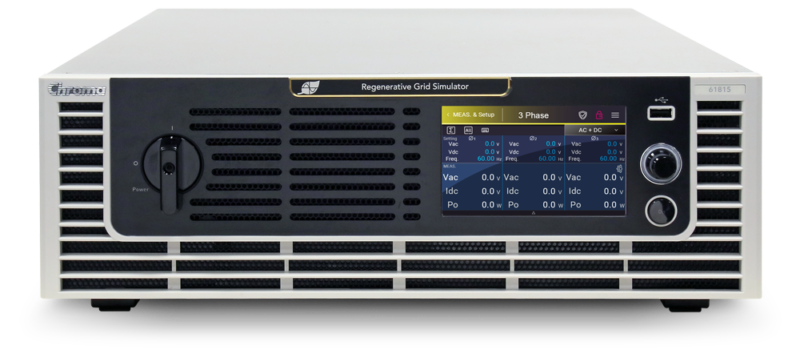
Specifically engineered for hair-pin motor stators, motor armatures, and high-frequency power inductors. Utilizes high-speed pulse surge discharge combined with high-frequency voltage sampling to detect inter-turn PD inception voltage (PDEV).
High-Power Regenerative Grid & Component Test System
Grid & Switchgear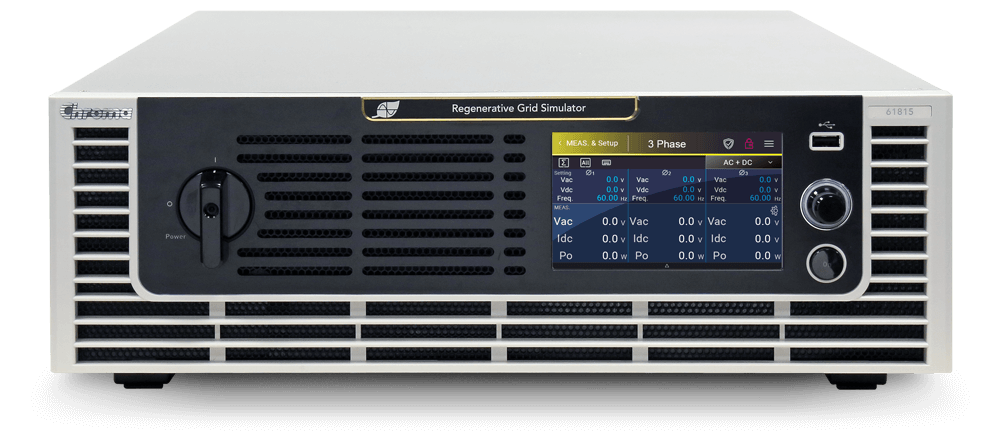
Integrated grid simulator platform capable of driving high-voltage transformers, switchgears, and solar PV inverters under real-world harmonic grid stress while monitoring continuous partial discharge emissions.
Multi-Channel High-Voltage Power Electronics Insulation System
AI Servers & Power Semi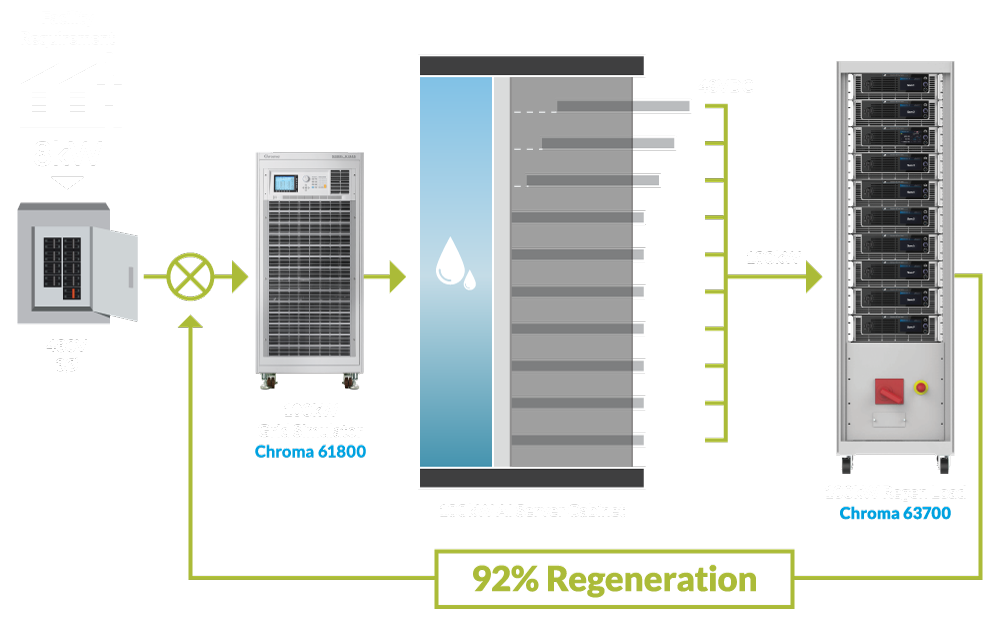
Multi-channel automated test equipment (ATE) designed for high-density AI server power supplies, SiC converter modules, and solid-state transformers requiring continuous PD Inception Voltage (PDIV) and Extinction Voltage (PDEV) profiling.
Global Procurement Trends: What Sourcing Directors & Chief Engineers Need to Know
As global industries transition toward 800V EV architectures, ultra-high-density AI datacenters, and smart microgrids, the strategy for procuring a Partial Discharge Tester has shifted dramatically. Procurement teams can no longer rely on simple pass/fail Hi-pot safety testers. Today's global buyers are demanding holistic insulation intelligence platforms.
1. Transition from Offline Spot-Checking to Continuous Automated Line Integration
Historically, partial discharge testing was restricted to high-voltage research laboratories and periodic field maintenance of utility transformers. Today, Tier-1 automotive suppliers and high-density power supply OEMs are installing inline automated Partial Discharge Testers directly on assembly lines. Integrating high-speed PD testing into automated end-of-line (EOL) test cells enables 100% screening of hairpin motor stators, onboard chargers (OBC), and power modules, catching sub-surface insulation defects before products are shipped to global customers.
2. Demand for High Noise-Rejection & Adaptive EMI Suppression Algorithms
Modern manufacturing environments are plagued by heavy electromagnetic interference (EMI) originating from industrial variable frequency drives (VFDs), robotic welding units, and switching power electronics. Standard legacy PD meters suffer from false-positive flags caused by ambient factory background noise. Sourcing trends favor next-generation Partial Discharge Testers equipped with dual-stage hardware filtering, spatial noise cancellation antennas, and digital wavelet transform algorithms capable of isolating true PD pulses as small as 0.5 pC in high-noise factory environments.
3. Total Cost of Ownership (TCO) & Multi-Function Modular Architecture
Buying standalone Hipot testers, surge testers, and partial discharge units increases total capital expenditure (CapEx) and rack footprint. Technical sourcing directors actively seek unified, multi-functional ATE systems that combine AC/DC dielectric withstand, insulation resistance (IR), impulse surge, and partial discharge detection into a single automated chassis controlled by open-architecture software API.
| Evaluation Parameter | Legacy Hipot/Insulation Testers | Modern Digital Partial Discharge Tester | Chroma Integrated PD ATE System |
|---|---|---|---|
| Primary Defect Coverage | Gross insulation shorts, air gaps | Microscopic void discharge, corona, tracking | Complete dielectric screening, PDEV/PDIV, impulse surge |
| Defect Detection Limit | Leakage current > 100 µA | Apparent charge > 1 pC | Ultra-sensitive < 0.1 pC with hardware active filtering |
| Test Non-Destructiveness | Low (High voltage can stress/damage insulation) | High (Detects micro-defects at low stress levels) | 100% Non-destructive with precise voltage ramp profiling |
| Diagnostic Capabilities | Pass / Fail current limit threshold | PRPD 2D/3D visual pattern analysis | AI Neural Network PRPD pattern classification & trending |
| Production Line Line Speed | Slow (Manual connection & ramp down) | Moderate (Lab setup required) | Ultra-Fast (Automated multi-channel switching & EOL integration) |
Technology Roadmap: The Future of Partial Discharge Measurement Technology
Driven by artificial intelligence, IoT connectivity, and advanced signal processing, Partial Discharge Testers are undergoing rapid technological evolution. Engineers developing next-generation high-voltage components must understand these critical engineering trends:
AI & Neural Network PRPD Pattern Recognition
Modern PD instruments leverage deep convolutional neural networks (CNNs) trained on millions of discharge pulse waveforms. The system automatically categorizes discharges into internal void, surface discharge, corona, or background noise with over 98% diagnostic accuracy, eliminating human operator error.
Ultra-High Frequency (UHF) Multi-Sensor Fusion
Combining galvanic IEC 60270 coupling circuits with non-intrusive High-Frequency Current Transformers (HFCT), Transient Earth Voltage (TEV) sensors, and UHF electromagnetic antennas (300 MHz – 1.5 GHz) to provide 3D spatial pinpointing of partial discharge location inside complex gas-insulated switchgear (GIS) or large power transformers.
Bipolar PWM High-Frequency Voltage Excitation
Traditional PD testing relies on 50/60 Hz sinusoidal voltage. Next-gen testers synthesize bipolar high-frequency square wave and PWM pulse trains (up to 100 kHz) to replicate the exact electrical stress imposed by SiC/GaN wide-bandgap motor drives on magnet wires.
By embedding these advanced technologies into test instruments, Chroma ensures that research labs and high-volume production facilities can quantify Partial Discharge Inception Voltage (PDIV) and Partial Discharge Extinction Voltage (PDEV) with unparalleled repeatability and confidence.
Frequently Asked Questions (FAQ) — Sourcing & Technical Guide
Below are expert answers to the most frequent technical, compliance, and procurement questions submitted by global test engineers, quality managers, and purchasing officers when evaluating Partial Discharge Testers.
- Coupling Capacitors (CC): Galvanic connection used for laboratory and off-line factory testing according to IEC 60270. Offers highest sensitivity ($< 0.1\text{ pC}$).
- High-Frequency Current Transformers (HFCT): Clamped around cable ground shields or earth straps for non-intrusive online PD detection.
- Transient Earth Voltage (TEV) Sensors: Capacitive couplers placed on external metallic switchgear enclosures to detect high-frequency transient voltage pulses induced by internal discharge.
- Ultra-High Frequency (UHF) Sensors: Internal or external antennas detecting electromagnetic waves in the 300 MHz – 1.5 GHz range inside gas-insulated switchgear (GIS) and power transformers.
Why Leading Global Manufacturers Partner with Chroma Systems Solutions
For over four decades, Chroma Systems Solutions has been the recognized worldwide leader in high-precision power electronics, electrical safety, and automated test equipment (ATE). When you source a Partial Discharge Tester or complete insulation test system from Chroma, you leverage unmatched engineering heritage and global support infrastructure.
40+ Years of Engineering Innovation
With decades of mastery in programmable AC/DC power sources, electronic loads, and automated safety test systems, Chroma provides un-rivaled measurement fidelity and system-level calibration accuracy trusted by global tier-1 manufacturers.
Regenerative & Eco-Friendly Systems
Our high-power test equipment features up to 92% regenerative energy recovery back to the grid. Reduce factory heat load, lower electricity overhead, and diminish operating costs while conducting high-voltage insulation tests.
Global Calibration & Service Support
Supported by ISO 17025 accredited calibration laboratories and dedicated application engineering hubs across North America, Europe, and Asia, ensuring your production lines remain compliant and operational 24/7.
Consult with our senior application engineers to review your test specifications, select the right Partial Discharge Tester configuration, schedule a live laboratory demonstration, or request a custom turnkey ATE system quote.