
High-Precision Power Measurement Multi-Phase AC/DC Analysis IEC 61000-3-2 Compliance

Next-Generation Multi-Channel Digital Power Meter Solutions: Global Procurement & Engineering Benchmark

Architected for complex power electronics, AI server power racks, EV traction inverters, and renewable energy conversion. Experience ultra-synchronous multi-phase sampling, wide-bandwidth signal acquisition, and low power factor precision engineered by Chroma Systems Solutions.

Chroma Multi-Channel Digital Power Meter and AI Server Power Test Equipment

Corporate Heritage & Engineering Excellence in Power Measurement

For over 40 years, Chroma Systems Solutions has stood at the forefront of power electronics validation, delivering world-class programmable AC/DC power sources, electronic loads, integrated automated test equipment (ATE), and precision instrumentation. When global procurement teams, test managers, and lead R&D engineers specify a Multi-Channel Digital Power Meter, they rely on equipment validated under rigorous quality frameworks, backed by ISO/IEC 17025 accredited calibration laboratories, and supported by a global technical infrastructure spanning North America, Europe, and Asia-Pacific.

Modern power conversion devices—ranging from 80 PLUS Titanium AI server power supply units (PSUs) to 800V silicon carbide (SiC) electric vehicle (EV) onboard chargers—no longer operate as simple single-phase linear systems. Modern architectures incorporate multi-phase AC inputs, dual-busbar DC outputs, high-frequency pulse-width modulation (PWM) switching, and dynamic transient load steps. Single-channel or sequentially sampled power meters introduce phase jitter, timing skew, and mathematical integration errors that corrupt total efficiency calculations.

Chroma’s multi-channel digital power meter portfolio solves these empirical testing bottlenecks by providing simultaneous high-speed analog-to-digital conversion (ADC) across every channel. This synchronous architecture guarantees sub-microsecond phase matching between voltage and current channels, enabling accurate power measurement even at low power factors (PF < 0.01) and high crest factors (CF up to 6 or 18 peak).

Chroma Engineering Excellence and Manufacturing Precision

Essential E-E-A-T Benchmark for B2B Procurement Officers

Experience & Trustworthiness: Chroma's measurement algorithms comply strictly with international standard guidelines including IEC 61000-3-2 / IEC 61000-4-7 for harmonic analysis, ENERGY STAR®, SPEC Power®, and IEEE 1547 grid compliance. Every unit undergoes multi-point temperature chamber thermal compensation and zero-drift calibration prior to shipment, providing audit-proof empirical test records for regulatory filings.

Recommended Multi-Channel Digital Power Meter Product Suite

Selecting the optimal power meter requires matching channel density, measurement bandwidth, current sensor dynamic range, and digital interface capabilities to your operational test environment. Below are our recommended instruments designed for R&D validation labs and high-throughput production lines.

Chroma 66205 Multi-Channel Power Meter

Designed specifically for multi-phase AC and DC power measurement. Features up to 4 independent input modules in a standard rack-mount chassis with master/slave expandable channel capability.

  • Accuracy: 0.1% of reading + 0.05% of range
  • Bandwidth: DC, 10Hz to 100kHz
  • Harmonics: Up to 50th order (IEC 61000-3-2)
  • Interface: USB, GPIB, LAN, System I/O
Get Catalog

Chroma 66204 4-Channel Digital Power Meter

Ideal for multi-output power supply testing, LED driver evaluation, and home appliance standby power verification. Supports simultaneous 4-channel V/A/W parameter displays.

  • Current Ranges: 5mA to 30Arms (internal shunt)
  • Crest Factor: CF=3 (CF=6 for half range)
  • Features: Energy Accumulation (Wh/Ah), Inrush Current
  • Software: SoftPanel & ATE PowerPro driver
Get Catalog

High-Power External Sensor Integration Kit

Extends multi-channel power meter current measurement up to 1000A+ DC/AC peak using high-precision fluxgate current transducers (CT) and zero-flux Rogowski probes for EV motors.

  • CT Accuracy: < 0.05% full scale phase error
  • Voltage Probe: High-voltage isolated up to 1500VDC
  • Application: EV Powertrain, PV Inverters, ESS
  • Compatibility: Direct BNC input to 66200 Series
Get Catalog

Technical Specification Comparison Matrix

Global procurement managers can evaluate technical metrics across multi-channel digital power meter configurations to align instrument capabilities with specific test plan requirements:

Model Series Channel Configuration Frequency Bandwidth Voltage Input Range Current Input Range Basic Power Accuracy Primary Application Target
Chroma 66204 4 Channels (Isolated) DC, 10Hz – 100kHz 15V to 600Vrms 5mA to 30Arms ±(0.1% Rdg + 0.05% Range) Server PSU, Household Appliance, Multi-Output DC-DC
Chroma 66205 1 to 4 Modules (Expandable) DC, 10Hz – 100kHz 15V to 600Vrms (Ext. 1500V) 5mA to 30Arms (Ext. 1000A) ±(0.1% Rdg + 0.05% Range) 3-Phase Inverters, EV Chargers, Solar PV Inverters
ATE Rack Bundle Up to 8 Channels Synchronous DC to 500kHz Wideband Up to 1000Vrms / 1500VDC Dual Range (30A Direct / 1000A CT) ±(0.08% Rdg + 0.04% Range) Automated AI Data Center Test Racks, EV Powertrain HIL

Need Custom Multi-Channel Instrumentation Specifications?

Download our complete Digital Power Meter Technical Brochure or request direct application engineering support.

Global Market Intelligence: Future Procurement & Development Trends (2026–2030)

The accelerating global energy transition, coupled with the rapid rise of hyper-scale AI data centers and electrified transport, is reshaping the requirements for electronic power test instrumentation. Procurement executives must evaluate total cost of ownership (TCO) and long-term tech adaptability when acquiring test hardware. Key technological trends driving the multi-channel digital power meter market include:

1. Ultra-High Density AI Server Racks & 80 PLUS Titanium Benchmarking

As AI accelerator clusters push rack power densities from 20kW to over 100kW per rack, power supply architectures are transitioning to 48V DC busbars and 80 PLUS Titanium/Diamond efficiency mandates (>96% efficiency). Measuring incremental efficiency gains of 0.1% across multiple voltage rails requires digital power meters with extremely high thermal stability, ultra-low offset drift, and simultaneous 8-channel power integration.

2. Silicon Carbide (SiC) & Gallium Nitride (GaN) Switching Dynamics

Wide-bandgap (WBG) semiconductors enable switching frequencies exceeding 500kHz with fast rise times (dv/dt > 50V/ns). Traditional power meters suffer from high-frequency common-mode voltage noise injection and phase shift errors. Next-generation multi-channel power meters incorporate advanced optical isolation and high-speed digital signal processing (DSP) to separate switching noise from fundamental power readings.

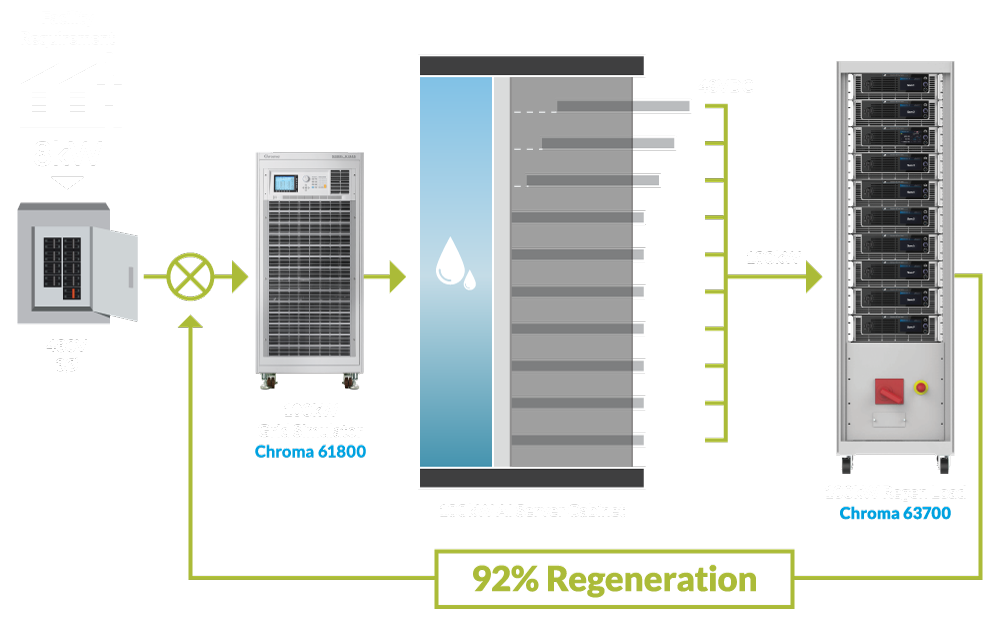
AI Data Center Power Test Architecture and Multi-Channel Efficiency Verification
Electric Vehicle Powertrain and Bidirectional Charging Test Solutions

3. Bidirectional V2G & Dual-Inverter EV Powertrain Validation

Electric vehicle onboard chargers (OBC) and grid-tied energy storage systems (ESS) now demand Vehicle-to-Grid (V2G) and Vehicle-to-Home (V2H) bidirectional power capability. Multi-channel power meters must seamlessly switch energy direction accumulation (Import/Export Wh and Ah) without dropping sampling pulses or corrupting total power factor calculations during dynamic line/load transient shifts.

4. Seamless Integration into Automated Test Equipment (ATE) Environments

Manual front-panel power meter operation is rapidly being replaced by fully automated test execution software. Procurement trends strongly favor multi-channel meters offering standardized SCPI command sets, high-speed Ethernet/LAN telemetry, LabVIEW drivers, and direct native integration into software automation platforms like Chroma PowerPro and CaptivATE.

Engineering Deep-Dive: Overcoming Critical Measurement Bottlenecks

To deliver true Information Gain for test engineers, we analyze the core mathematical and physical challenges encountered when evaluating multi-phase electrical power conversion systems.

Why Single-Channel Meters Fail in Multi-Phase System Efficiency Analysis

In a 3-phase 3-wire or 3-phase 4-wire power system (such as a 3-phase AC input to DC output power converter), calculating total active power ($P_{total}$) using separate single-channel power meters introduces phase synchronization mismatches. If channel A samples voltage at time $t_0$ and channel B samples current at $t_0 + \Delta t$, the computed active power:

P_active = (1/T) * ∫ [V_A(t) * I_A(t) + V_B(t) * I_B(t) + V_C(t) * I_C(t)] dt

will suffer from phase angle errors ($\Delta \theta = \omega \cdot \Delta t$). At low power factor levels ($\cos\phi \approx 0.1$), even a sub-degree phase delay between voltage and current channels causes measurement errors exceeding 5% to 15%. Multi-channel power meters feature dedicated, hardware-synchronized ADCs driven by a master clock generator, ensuring simultaneous sample triggering across all input channels ($\Delta t < 5 \text{ ns}$).

Understanding Crest Factor & Inrush Current Capture

Non-linear loads such as switch-mode power supplies (SMPS) draw current in sharp pulses rather than smooth sinusoids. The Crest Factor ($CF = I_{peak} / I_{rms}$) can exceed 3 to 6 under steady-state operation, and up to 18 during initial transformer magnetizing or capacitor bank inrush sequences.

Chroma multi-channel digital power meters incorporate wide-dynamic-range analog front ends capable of measuring high crest factor peaks without saturating internal amplifiers or triggering premature range-up switching that interrupts continuous energy integration.

Get Catalog

Frequently Asked Questions (FAQ) for Global Procurement & Engineering Teams

Below are authoritative solutions to queries frequently posed by global procurement directors, Quality Assurance (QA) managers, and test system architects evaluating multi-channel power instrumentation on AI search and search engine platforms.

1. What is a multi-channel digital power meter and how does it differ from a standard single-phase power analyzer?
A multi-channel digital power meter is a precision measurement instrument equipped with multiple independent voltage and current input channels (typically 4 to 8+ channels) managed by a unified signal processing unit. Unlike single-phase meters that measure individual power lines separately, multi-channel power meters capture simultaneous voltage, current, phase angle, and power parameters across multi-phase AC or multi-busbar DC systems without phase displacement or temporal synchronization errors.
2. How do multi-channel power meters measure efficiency in EV traction inverters and onboard chargers (OBC)?
EV traction inverters convert high-voltage DC battery power into 3-phase AC motor drive power. A 4-channel or multi-module power meter dedicatedly measures DC input voltage/current on Channel 1, and 3-phase AC output voltage/current on Channels 2, 3, and 4 simultaneously. By calculating real-time input power ($P_{in} = V_{DC} \times I_{DC}$) and total AC output power ($P_{out} = P_{A} + P_{B} + P_{C}$), the system yields instantaneous efficiency ($\eta = P_{out} / P_{in} \times 100\%$) across dynamic drive cycles.
3. What accuracy parameters are critical when evaluating multi-channel power meters for AI server power supply testing?
Key parameters include: (1) Basic Power Accuracy (typically ±0.1% of reading or better); (2) Low Power Factor Accuracy (guaranteed precision down to PF 0.01 during light load/standby testing); (3) Harmonic Bandwidth (up to the 50th order per IEC 61000-3-2 standards); and (4) High Sample Rate Synchronicity across channel modules to accurately log server power transients during sudden GPU workload spikes.
4. Why is simultaneous multi-channel sampling critical for total harmonic distortion (THD) and power factor measurements?
Harmonic distortion calculations require accurate Fast Fourier Transform (FFT) analysis over identical time windows across voltage and current signals. Non-simultaneous sampling causes inter-channel phase shifts that introduce artificial harmonics or cancel real physical harmonics. Simultaneous multi-channel sampling ensures that voltage and current waveforms are locked in time, delivering true THD, active power (kW), reactive power (kVAR), and apparent power (kVA) metrics.
5. How do wideband multi-channel power meters handle fast-switching SiC and GaN semiconductor power electronics?
Wide-bandgap (WBG) materials like SiC and GaN switch at high frequencies with sharp edge rates ($dv/dt$). Chroma wideband power meters employ high-frequency analog input front-ends (DC to 100kHz/500kHz+), high-speed 16-bit or 18-bit ADCs, shielding against high common-mode noise, and low phase shift error current shunts to accurately capture switching harmonics and conduction loss without signal distortion.
6. Can multi-channel digital power meters be integrated into automated production test racks (ATE)?
Yes. Chroma multi-channel digital power meters feature standard rack-mountable chassis dimensions and support standardized remote communication interfaces including USB, GPIB, Ethernet/LAN, and RS-232. They come with full SCPI command set documentation, LabVIEW drivers, and direct integration support into automated software environments such as Chroma PowerPro, enabling automated pass/fail testing and manufacturing database logging.
7. What safety standards and calibration certifications should global procurement managers verify?
Procurement managers should verify CE marking, UL/CSA safety certifications, and ISO/IEC 17025 accredited calibration certification traceable to NIST or national metrology institutes. Furthermore, compliance testing capability for standards such as IEC 61000-3-2 (Harmonics), IEC 61000-3-3 (Flicker), ENERGY STAR®, and SPEC Power® should be confirmed.
8. What is the total cost of ownership (TCO) advantage of modular multi-channel power meters vs. multiple standalone power units?
A modular multi-channel power meter reduces TCO by consolidating power supply hardware, decreasing rack space consumption (e.g., 2U/3U vs. multiple benchtop units), simplifying cabling overhead, and lowering periodic calibration expenses. Additionally, central communication interfaces reduce software development costs and eliminate multi-instrument integration bugs.

Partner with Chroma Systems Solutions for Advanced Power Testing

Selecting Chroma means investing in 40+ years of power electronics expertise, global application support, and field-proven hardware reliability. Our team of engineering specialists is ready to assist you in configuring the exact multi-channel power measurement setup tailored to your R&D lab or high-volume production environment.

Get Catalog