
Power Electronics & Test Technical Knowledge Base
Explore technical articles, industry insights, and power testing innovations from Chroma engineering experts.
China Top Bidirectional DC Power Supply Manufacturers
Table of Contents
- Bidirectional DC Power Supply Technology and Operating Principles
- Key Product Types and Performance Specifications
- Leading China-Based Bidirectional DC Power Supply Manufacturers
- Manufacturer Comparison by Applications and Technical Capabilities
- Selection Criteria, Certification, and After-Sales Support
- FAQS
- Conclusion
- Related Posts
China’s Bidirectional DC Power Supply market is gaining strategic importance as electric vehicles, battery storage, and laboratory testing become more closely connected. The International Energy Agency’s Global EV Outlook 2025 reported that global electric car sales exceeded 17 million in 2024, while China accounted for more than 11 million units. That scale creates demand for power equipment that can deliver energy accurately and return it safely.
A Bidirectional DC Power Supply can simulate battery charging, absorb regenerative energy, and support vehicle-to-grid testing. In a 19-inch rack, a 100 kW system may need to manage hundreds of amps at high-voltage DC. Small efficiency differences then become measurable heat, operating cost, and cooling requirements. Willett Kempton, a pioneer of vehicle-to-grid research, has described electric vehicles as “mobile energy storage.” His observation remains practical, not theoretical.
This article examines China’s leading manufacturers through specifications, control performance, protection design, certification experience, and after-sales capability. The IEA and the U.S. Department of Energy both identify bidirectional charging as an important tool for flexible energy systems. Yet published ratings do not tell the whole story. Some suppliers emphasize peak power while giving little detail about continuous operation, response time, or reverse-power stability. That gap deserves attention. No ranking is perfectly permanent. Firmware changes, factory audits, and field results can alter the picture. The following overview therefore focuses on evidence that buyers can verify, including test reports, thermal behavior, communication protocols, and real application records.
Bidirectional DC Power Supply Technology and Operating Principles
China Top Bidirectional DC Power Supply Manufacturers
Bidirectional DC Power Supply Technology and Operating Principles
A bidirectional DC power supply can deliver energy to a load and absorb it during testing. The power stage usually contains switching transistors, inductors, capacitors, sensors, and a digital control loop. In source mode, electrical energy moves from the grid-side converter toward the DC terminals. In sink mode, the current reverses direction. The loop is reversible.
Voltage and current sensors measure real-time operating conditions. The controller compares these values with programmed references, then adjusts switching duty cycles within milliseconds. Constant-voltage mode protects sensitive equipment, while constant-current mode supports battery charging and controlled discharge. Some systems also regulate power, resistance, or battery simulation profiles.
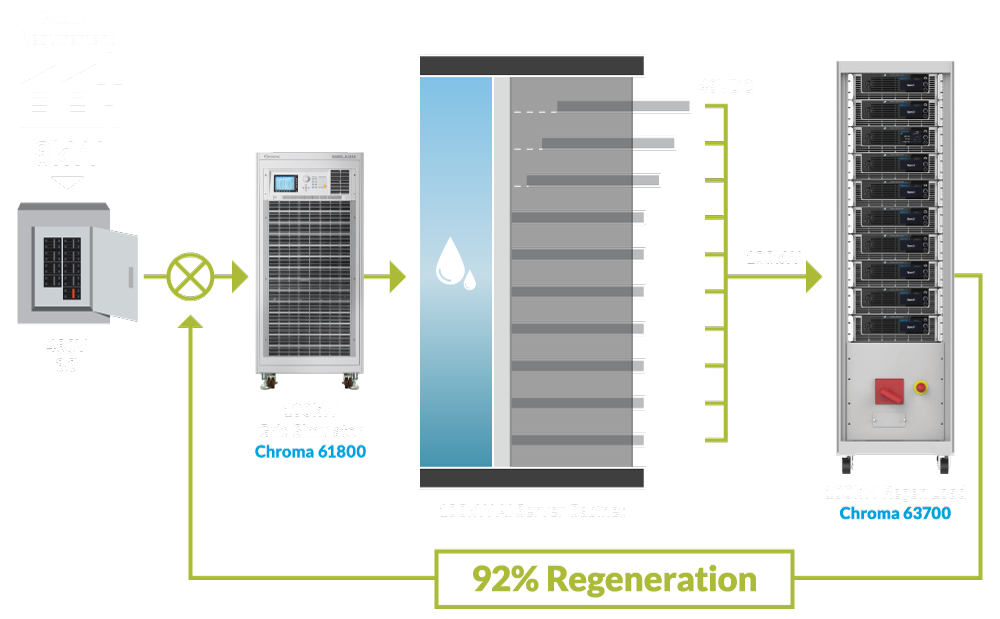
Energy recovery is a major practical advantage. Instead of wasting discharge power as heat, the converter can return suitable energy to the internal bus or utility interface. Engineers must still check isolation, grounding, thermal margins, and fault response. A test may look stable at low power, yet become noisy near the maximum rating. Real systems are less tidy.
Experienced manufacturers in China often evaluate efficiency across several voltage and current points, not only at the nameplate rating. During commissioning, technicians should verify polarity, response time, ripple, overshoot, and emergency shutdown behavior. Cable inductance can distort fast transients. This detail is easy to miss. The operating principle seems simple, but accurate control depends on sensors, software, cooling, and careful calibration.
Key Product Types and Performance Specifications
China Top Bidirectional DC Power Supply Manufacturers
China’s leading bidirectional DC power supply manufacturers offer several product types for laboratories, production lines, and energy testing. Benchtop units suit battery experiments and compact development benches. Rack-mounted models provide higher output power with programmable control. Modular systems are useful when test capacity may expand later. High-power cabinet systems support electric vehicle, battery, and grid equipment testing.
Key specifications deserve careful comparison. Check voltage and current ranges, not only maximum power. A 100 kW unit may reach its rating only within a limited voltage window. Four-quadrant operation supports both sourcing and sinking energy. Important performance details include conversion efficiency, output ripple, voltage accuracy, current accuracy, and transient response. Regenerative efficiency also matters because returned energy can reduce facility consumption. Communication options may include CAN, Ethernet, USB, or industrial fieldbus interfaces. Safety features should include isolation, over-temperature protection, over-voltage protection, and emergency shutdown support. In practice, published figures can vary with temperature and load. Ask for test conditions.
Tips: Compare continuous ratings with short-term ratings. Request a sample test report. Confirm cooling requirements early. A quieter system may be preferable in a laboratory, but it can require lower power density. I have found that control software is often overlooked. Poorly designed interfaces can slow testing, even when the hardware performs well. Leave margin for cable loss, future voltage changes, and imperfect operating conditions.
Leading China-Based Bidirectional DC Power Supply Manufacturers
China Top Bidirectional DC Power Supply Manufacturers
Leading China-Based Bidirectional DC Power Supply Manufacturers
Leading China-based manufacturers are developing bidirectional DC power supplies for batteries, electric drives, laboratory testing, and energy storage systems. These units can source power during charging and return energy during discharge. That reduces heat and operating waste.
In practical sourcing, engineers examine more than rated voltage and current. They check response time, ripple, efficiency, isolation, cooling, and protection functions. A dependable supplier should provide traceable testing records, calibration data, and clear technical drawings. Factory audits can reveal wiring quality, thermal design, and assembly discipline.
Many Chinese manufacturers support custom voltage ranges, communication interfaces, cabinet sizes, and parallel operation. This flexibility helps integrators match equipment to a specific production line. Ask for a sample test under real load conditions. A polished datasheet is not enough.
Safety remains central. Manufacturers should design for overvoltage, overcurrent, short-circuit, overheating, and reverse-polarity risks. They should also explain compliance with applicable international requirements. Certifications matter, but test evidence matters more.
Some projects expose an uncomfortable issue: delivery speed can pressure verification. That is where buyers may compromise too early. A better process includes factory acceptance testing and documented corrective actions. Small details matter. Loose terminals, noisy fans, or unclear firmware updates can create costly downtime. Reliable China-based suppliers combine engineering experience, responsive communication, and repeatable quality control across production batches.
Manufacturer Comparison by Applications and Technical Capabilities
China Top Bidirectional DC Power Supply Manufacturers
Manufacturer comparison should begin with application fit, not catalogue power. The IEA’s Global EV Outlook 2024 reports nearly four million public charging points worldwide by the end of 2023. This growth increases demand for bidirectional DC supplies in vehicle testing, battery recycling, microgrids, and energy storage laboratories.
For EV testing, compare output range, response speed, current ripple, and regenerative efficiency. A practical unit may need 800 V operation, millisecond-level control, and stable four-quadrant performance. For battery production, measurement accuracy and insulation monitoring matter more than maximum power. In microgrid projects, engineers should examine grid synchronization, islanding control, communication protocols, and fault recovery. The U.S. Department of Energy’s 2024 vehicle technology assessments continue to identify power conversion efficiency and thermal management as major system-level concerns.
Look closely at cooling design. Air cooling may suit a compact laboratory rack, while liquid cooling can support continuous high-power cycling. Test documentation also deserves attention: calibration records, protection thresholds, and harmonic measurements reveal more than promotional curves. IEC 61800-5-2 and IEC 61000 series requirements can guide safety and electromagnetic compatibility checks.
Numbers can mislead.
A 500 kW rating is useless if the supply derates after ten minutes. This comparison is imperfect because published efficiency often reflects ideal temperature and voltage conditions. Buyers should request witnessed tests at partial load, regenerative operation, and repeated voltage changes. Service response, firmware traceability, and local technical support remain practical differentiators.
Selection Criteria, Certification, and After-Sales Support
China Top Bidirectional DC Power Supply Manufacturers
Selecting a bidirectional DC power supply starts with the application, not the catalog. During commissioning, engineers should check voltage range, current stability, response time, isolation, and regenerative efficiency. A 600 V unit may look suitable, yet its continuous power rating can fall sharply at higher temperatures. Fit matters. According to the IEA Global EV Outlook 2024, electric car sales approached 14 million in 2023. This growth increases demand for reliable battery cycling and vehicle testing equipment.
Certification requires careful verification. Buyers should request test reports, declaration documents, and traceable serial records. IEC 62477-1 supports safety assessment for power electronic systems, while IEC 61010-1 addresses measurement and laboratory equipment. EMC evidence should match the intended environment, including relevant IEC 61000 requirements. ISO 9001 certification is useful, but it does not prove product performance. Ask for thermal data, calibration results, and protection tests. Numbers matter more than polished brochures.
After-sales support often decides long-term value. Confirm response times, spare-part availability, remote diagnostics, firmware procedures, and local service coverage. The U.S. Department of Energy’s Vehicle Technologies Office has repeatedly highlighted testing quality and battery reliability as key development concerns. A supplier should explain how faults are logged after installation. Test it. Poor documentation remains a common weakness, even among technically capable manufacturers. Buyers should also review warranty exclusions, because regenerative operation may be treated differently from one-way output. That detail can become expensive.
China Top Bidirectional DC Power Supply Manufacturers: Selection Criteria, Certification, and After-Sales Support
This illustrative procurement model prioritizes electrical performance, bidirectional control, applicable safety and EMC compliance, reliability, after-sales support, and system integration. Certification checks may include IEC 62477-1, IEC 61010-1, IEC 61326-1, ISO 9001, and market-specific requirements such as CE or UKCA. Buyers should verify the applicable edition, test reports, declaration of conformity, warranty terms, spare-parts availability, response time, and remote-support capability for the intended voltage and power range.
FAQS
It sends energy to a test device and absorbs energy during discharge. The current direction can reverse. This makes testing more flexible.
Switching transistors, inductors, capacitors, sensors, and digital controls manage the reversible power stage. Sensors measure voltage and current continuously.
Constant-voltage mode protects sensitive equipment. Constant-current mode supports controlled charging and discharge. Some systems also simulate power, resistance, or battery profiles.
Discharge energy can return to an internal bus or utility interface instead of becoming waste heat. This may reduce facility energy use.Energy recovery is not automatic.
Compare voltage range, current range, continuous power, efficiency, ripple, accuracy, and transient response. Check the actual voltage window for rated power.A high rating can mislead.
Benchtop units suit compact laboratory work. Rack-mounted systems provide programmable power. Modular designs allow expansion. Cabinet systems support high-power testing.Space and cooling matter.
Look for isolation, grounding provisions, overvoltage protection, overcurrent protection, short-circuit response, thermal protection, and emergency shutdown support.Polarity errors can be costly.
Request calibration data, traceable test records, technical drawings, and sample results under realistic loads. Factory acceptance testing can reveal wiring and cooling problems.A polished datasheet is not enough.
Cable inductance can distort fast transients. Cooling requirements may change with load. Leave margin for cable loss, voltage changes, and imperfect conditions.The real system is messier.
Conclusion
This article provides a practical overview of Bidirectional DC Power Supply technology, explaining how these systems transfer energy in both directions between a power source and a load. It examines key product types, including programmable, regenerative, high-power, and modular solutions, while highlighting important specifications such as voltage range, current capacity, power density, conversion efficiency, response speed, control accuracy, and communication functions.
It also introduces major China-based manufacturing capabilities from an industry perspective without focusing on specific brands, comparing suppliers by applications, engineering expertise, customization options, production quality, and technical support. Typical uses include battery testing, electric vehicle development, energy storage evaluation, power electronics research, and automated production testing. Finally, the article outlines essential selection criteria, including safety design, international certifications, quality management, software compatibility, warranty terms, training, maintenance, and after-sales service, helping buyers choose reliable equipment for their technical and operational requirements.

Blog Tags: