
Technical Blog & Insights

Power Electronics & Test Technical Knowledge Base

Explore technical articles, industry insights, and power testing innovations from Chroma engineering experts.
0%

Choosing a Regenerative AC Grid Simulator in 2026 means looking beyond its power rating. The right system must reproduce grid conditions accurately, absorb returned energy, and protect the equipment under test. A voltage trace may look clean on screen, yet source impedance or a slow transient response can distort the result. Small details matter.

MIT power-electronics researcher David Perreault offers a useful systems-level perspective. A paraphrase of the principle reflected in his work is: “Evaluate the complete energy-conversion system, not one component in isolation.” This is a paraphrase, not a verified verbatim quotation. For buyers, that means checking four-quadrant operation, voltage and frequency ranges, power regeneration efficiency, harmonic performance, and response to sudden load changes. Ask for test data, not just headline specifications. Request a demonstration using your actual test profile, including startup, voltage dips, and abrupt transitions.

Then look at integration. Does the simulator support the required control interface? Can it reproduce unbalanced phases and programmable grid disturbances? Are calibration records, remote-operation features, and service support clearly documented? These questions help separate a capable platform from a costly mismatch. There is no universal best model. And specifications alone can mislead. A practical comparison should weigh test requirements, facility capacity, expansion plans, and total operating cost. Leave room for uncertainty, too: published efficiency figures may not reflect every operating point. A careful selection begins with the tests you must run, then verifies each claim against measurable evidence.

How to Choose a Regenerative AC Grid Simulator in 2026?

Define the Test Requirements and Intended Grid Applications

Before comparing a regenerative AC grid simulator, define what the test must prove. Identify the device under test, its rated voltage, phase configuration, frequency range, and maximum power. Include overload duration and expected operating conditions, not just nominal values. A unit tested only at steady state may behave differently during a voltage dip or a rapid frequency change. Small details matter.

Then map those requirements to the intended application. Grid-connected inverters may need programmable voltage and frequency profiles, harmonic control, and precise phase adjustment. Energy storage systems also require attention to bidirectional power flow and transitions between charging and discharging. For EV charging equipment, consider the input range and the response to supply disturbances. Microgrid testing can call for phase imbalance or changing grid conditions. List the actual test cases; broad labels can hide important gaps.

Check how the simulator will fit into the test setup. Confirm that its power rating covers the device and realistic operating margin, and verify measurement accuracy across the ranges you plan to use. Ask how test profiles are configured and whether results can be recorded with useful timing detail. This is where specifications can feel deceptively tidy. A spreadsheet will not reveal every awkward setup issue, so include cabling, cooling, and the available test space in your requirements.

Match Voltage, Frequency, Power, and Phase Specifications

Match the simulator to the equipment’s real operating envelope, not just its nominal rating. Record the required line-to-line and line-to-neutral voltages, frequency range, phase arrangement, and maximum current. For example, a three-phase test at 400 V line-to-line and 50 Hz needs different settings from a single-phase 230 V supply. Confirm whether the unit can reproduce brief voltage sags, frequency shifts, and phase imbalance. These conditions matter: the International Energy Agency’s Electricity 2024 report projected global electricity demand growth averaging 3.4% annually from 2024 to 2026. A changing grid makes realistic test limits more useful. Small margins matter.

Check power in both directions. A regenerative simulator returns absorbed energy to the supply, but its continuous power rating may differ from its short-duration peak rating. Compare those figures with the device under test, including startup surges and reactive loads. Also verify whether the stated rating applies per phase or across all phases. That detail is easy to miss. For phase-sensitive work, confirm phase sequence, synchronization accuracy, and independent phase control; a balanced output alone may not recreate the fault condition you need. IEEE 1159-2019 provides a recognized framework for describing power-quality disturbances, while IEC 61000-4-30 defines power-quality measurement methods. Use these references to specify test conditions, then ask for measured output accuracy across the full voltage and frequency range. A neat datasheet is not proof of performance. I would still request a witnessed test with the intended load connected.

Evaluate Regeneration Efficiency and Energy-Flow Capabilities

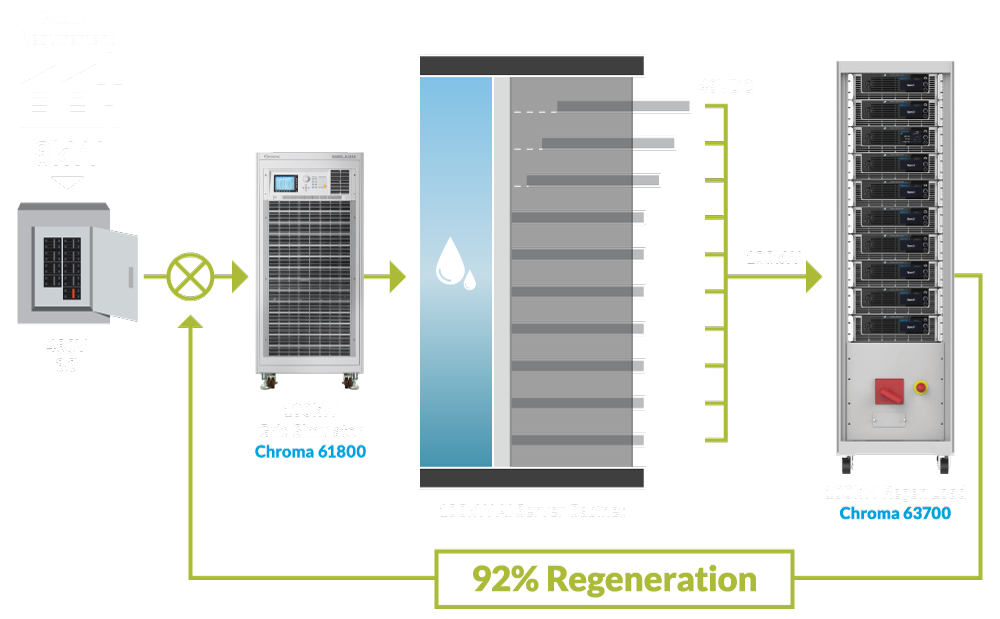
When comparing a regenerative AC grid simulator, look beyond its maximum power rating. The key question is where energy goes during operation. In regenerative mode, the unit returns part of the absorbed power to the facility supply instead of dissipating it as heat. The returned amount depends on operating conditions, conversion losses, and the quality of the installation.

Ask how regeneration efficiency is measured. A useful evaluation records input and returned energy at several voltage, frequency, and load points, not just one favorable setting. Check whether measurements include standby consumption and conversion losses. A calibrated power analyzer can reveal differences between power absorbed by the simulator and power actually returned. Small gaps matter over long test cycles. Not glamorous, but useful.

Also examine how smoothly the system changes between sourcing and absorbing power. Sudden transitions can affect test results, while excessive heat may limit sustained operation. Confirm the simulator’s power-flow data is logged clearly and that the site supply can accept returned energy. I would be cautious about a single headline efficiency figure; it rarely tells the whole story. A tidy laboratory result can still mislead if the test conditions do not match your intended use.

Check Safety Features, Standards, and System Compatibility

A regenerative AC grid simulator should protect both the test team and the equipment under test. Check for overvoltage, overcurrent, overtemperature, and emergency-stop protection. Look for clear interlocks, safe discharge behavior, and a documented response to faults. Small details matter. Can an operator isolate the output without reaching behind a live cabinet?

Review the applicable electrical-safety and electromagnetic-compatibility standards for your installation and intended use. Ask for test reports or conformity documents, not just a standards list. A certificate is not the whole answer; it may not cover your exact configuration. Requirements also vary by region and application, so verify them with your safety or compliance team. Compatibility needs equal care. Match the simulator’s voltage range, frequency, phase count, and power rating to your test plan. For regenerative operation, confirm how much power it can return and whether your facility can accept that energy. Check response speed, waveform quality, and transient capability against the devices you will test. Measure the available space and confirm cooling, wiring, and control-interface needs. One mismatch can turn a capable system into a frustrating installation. I would leave margin in the ratings, though the right margin depends on the test profile. Ask for a practical demonstration using representative loads before making a decision.

How to Choose a Regenerative AC Grid Simulator in 2026

Compare the simulator’s voltage and frequency range with the nominal mains systems you need to reproduce. These representative single-phase values are not a substitute for checking local supply specifications.

Selection checks: Confirm voltage, frequency, phase count, current and power ratings, plus both sourcing and regenerative-sinking capability. Review safety and EMC documentation for the intended use and jurisdiction—for example, IEC 61010-1, IEC 61326-1, and, where applicable, IEC 62477-1. Verify the scope of any certification rather than relying on a standard number alone.

Representative nominal values: United States 120 V / 60 Hz; Japan 100 V / 50 or 60 Hz; Europe 230 V / 50 Hz; Australia 230 V / 50 Hz; China 220 V / 50 Hz. Actual supplies and permitted tolerances may vary.

Compare Total Cost, Service Support, and Upgrade Options

When choosing a regenerative AC grid simulator in 2026, compare the full operating cost, not just the purchase price. Include installation, utility connection, cooling, scheduled calibration, and operator training. Regenerative operation can return energy to the facility, but actual savings depend on test profiles and local energy costs. Ask for a calculation based on your expected voltage, current, and operating hours. That adds up.

Service support matters when a test station stops. Check response hours, remote diagnostic access, repair procedures, and the availability of replacement modules. Ask how calibration is documented and whether technicians can support your site. A low-cost service plan may still leave long delays if critical parts are shipped from far away. Get response commitments in writing. Then check what they exclude.

Upgrade options can protect the investment as requirements change. Confirm whether power modules can be added, and whether control software supports future test sequences. Review voltage and frequency ranges, communication interfaces, and compatibility with existing safety systems. Request a clear upgrade path with estimated costs, not just a promise of flexibility. I would also test the interface before purchase; specifications do not reveal every awkward menu. Not always. Choose equipment that meets current needs without making expansion needlessly expensive.

How to Choose a Regenerative AC Grid Simulator in 2026? — Compare Total Cost, Service Support, and Upgrade Options

Indicative comparison of four system-size classes for planning and procurement. Cost ranges are budgetary estimates in USD, not vendor quotations; actual pricing depends on voltage, current, power quality, software, safety requirements, and delivery location.

Comparison Dimension 30 kVA Class 60 kVA Class 150 kVA Modular Class 300 kVA Modular Class
Typical fit Single-inverter development, laboratory validation, and small power-conversion prototypes. Medium-sized inverter testing, product qualification, and multi-unit development benches. Higher-power equipment testing, production engineering, and expandable laboratory systems. Large converter or distributed-energy testing where high power and future capacity growth are important.
Indicative AC power rating Approximately 30 kVA Approximately 60 kVA Approximately 150 kVA, often assembled from parallel power modules Approximately 300 kVA, commonly configured as a multi-module system
Common output voltage class Typically 208 V or 400/480 V three-phase, depending on configuration Typically 208 V or 400/480 V three-phase, depending on configuration Typically 400/480 V three-phase; other voltage arrangements may require options Typically 400/480 V three-phase; confirm voltage and current limits at rated power
Grid simulation functions to confirm Programmable voltage and frequency; basic voltage dips, swells, and phase control Programmable voltage and frequency; configurable phase, sequence, and disturbance profiles Advanced disturbance profiles, harmonic control, and synchronized multi-channel operation may be available Advanced profiles and coordinated operation; verify performance at full power and across parallel modules
Regenerative operation Can return absorbed test energy to the facility supply when designed for grid regeneration. Can return absorbed test energy to the facility supply when designed for grid regeneration. Regenerative operation can reduce the need to dissipate returned energy as heat; confirm permitted grid conditions. Regenerative operation can reduce cooling and energy-dissipation demands; confirm site interconnection requirements.
Indicative equipment budget $35,000–$55,000 $60,000–$95,000 $130,000–$220,000 $240,000–$420,000
Estimated commissioning and installation $3,000–$6,000 $5,000–$10,000 $10,000–$20,000 $20,000–$40,000
Indicative annual service allowance $2,000–$4,000 $3,000–$6,000 $6,000–$12,000 $10,000–$20,000
Estimated five-year total cost $48,000–$81,000 $80,000–$135,000 $170,000–$300,000 $310,000–$560,000
Service-support items to specify Remote diagnostics, software updates, warranty duration, and replacement-part lead times. Include response-time targets, calibration options, and availability of local field service. Request module-level repair options, on-site commissioning, and a documented preventive-maintenance plan. Require escalation procedures, critical-spares planning, on-site response terms, and service coverage for the complete system.
Upgrade path to evaluate Check whether control software, measurement functions, and interfaces can be added later. Confirm whether parallel operation or a higher-current configuration is supported. Ask whether capacity can be expanded by adding compatible modules without replacing the controller. Verify maximum supported parallel capacity, module interchangeability, and backward compatibility of controls.
Best value when Test loads are modest and a compact initial investment matters more than expansion. Current requirements exceed a small bench but do not justify a large modular installation. Power needs are substantial, and staged expansion or maintainability has measurable value. High-power testing is routine and the facility can support the required electrical infrastructure.

Cost assumptions: Five-year total cost is calculated as equipment budget + commissioning and installation + five years of the annual service allowance. It excludes taxes, financing, facility electrical upgrades, shipping, optional software, and energy costs. Before purchasing, verify rated power at the required voltage, regenerative operating limits, harmonic performance, safety compliance, service response commitments, and upgrade compatibility in the written specification.

FAQS

Which safety features should a regenerative AC grid simulator have?

Check for overvoltage, overcurrent, and overtemperature protection. Confirm emergency stops, clear interlocks, and safe discharge behavior. Ask how operators isolate the output without reaching behind a live cabinet.

How can I verify that the simulator meets relevant standards?

Review the standards that apply to your site and intended use. Request test reports or conformity documents for your exact configuration. A standards list alone is not enough.

What specifications should match my test plan?

Compare voltage range, frequency, phase count, and power rating. Check response speed, waveform quality, and transient capability against your test devices. Leave some rating margin, but choose it for your test profile.

What should I check before using regenerative operation?

Find out how much energy the simulator can return. Confirm that your facility can accept it. Any savings depend on test hours, load profiles, and local energy costs.

What installation details are easy to overlook?

Measure available floor space and check cooling, wiring, and control-interface needs. A small mismatch can delay setup. I might be overcautious here.

How should I compare the total operating cost?

Include installation, utility connection, cooling, calibration, and training. Ask for an estimate based on expected voltage, current, and operating hours. That adds up.

What service support should I ask about?

Check response hours, remote diagnostics, repair procedures, and replacement-module availability. Ask how calibration is documented and whether technicians can support your site. Get response commitments in writing.

How can I judge upgrade options before purchase?

Ask whether power modules can be added and future test sequences supported. Request estimated upgrade costs and check interface compatibility. Try the control menu with a representative setup; specifications may miss awkward details.

Conclusion

Choosing a Regenerative AC Grid Simulator in 2026 starts with defining the tests it must perform and the grid conditions it needs to reproduce. Consider whether your work involves equipment validation, power conversion testing, or grid-interaction studies, then match the simulator’s voltage, frequency, power rating, and phase configuration to those requirements. Allow for future test scenarios so the system is not limited to today’s needs.

Regeneration capability is also important: compare energy-return efficiency and the simulator’s ability to manage power flowing both to and from the device under test. Review protective features, applicable safety standards, and compatibility with existing equipment and control systems. Finally, assess the full cost of ownership, including installation, maintenance, service support, and potential upgrades. A well-matched Regenerative AC Grid Simulator can support reliable testing while helping your laboratory use energy and resources effectively.

Lila

Lila

Lila is a seasoned marketing professional with a deep expertise in our company's offerings, making her an invaluable asset to our team. With a passion for sharing knowledge and insights, Lila frequently publishes expertly crafted blog articles on our official website, where she delves into the......