
Power Electronics & Test Technical Knowledge Base
Explore technical articles, industry insights, and power testing innovations from Chroma engineering experts.
2026 Top Regenerative AC Electronic Load Which One to Buy?
Choosing a Regenerative AC Electronic Load in 2026 means looking beyond headline power ratings. These instruments draw energy from an AC source and can return it to the grid, reducing the heat produced by conventional loads. That matters in a busy test lab. But regeneration alone does not make a unit suitable for every application.
A useful comparison starts with the details on the datasheet: voltage and frequency ranges, current capacity, power factor, harmonic performance, transient response, and protection features. Check whether the load supports the operating modes your tests require, such as constant current, constant power, or programmable waveforms. Then consider the practical setup. A heavy unit may need dedicated floor space, while limited software support can slow routine testing. Small details count.
This guide looks at what buyers should compare when choosing a model, from test requirements and interface options to service support and total cost. It also distinguishes specifications that affect real workloads from features that may rarely be used. No shortlist is perfect. A high-power model can be excessive for a small engineering team, while a lower-cost option may lack needed measurement accuracy or control flexibility. The right choice depends on the equipment under test, expected duty cycle, and facility requirements. Before purchasing, verify published specifications with the manufacturer and confirm that the proposed configuration matches your test plan. One number is never enough.
How Regenerative AC Electronic Loads Work
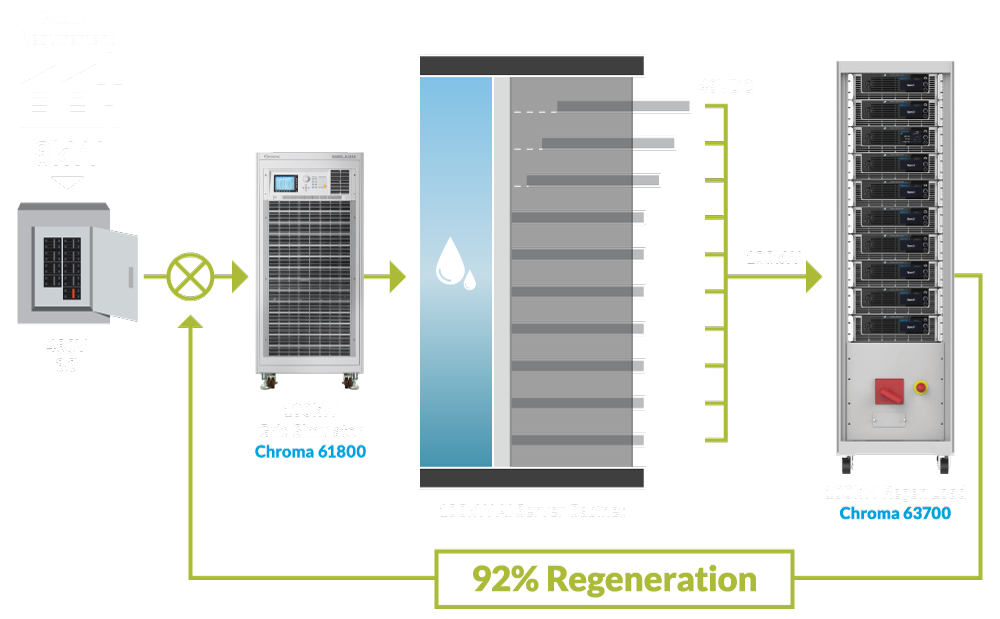
A regenerative AC electronic load absorbs power from a device under test, such as an inverter or grid-connected power supply. Its control system shapes the input current to match a programmed condition, including constant power, current, or power factor. Inside, an active rectifier converts the incoming AC power to a DC link. A grid-synchronized inverter then sends most of that energy back to the facility supply instead of burning it off as heat. That is the neat version. Conversion losses remain, and current distortion or unstable grid conditions can reduce performance.
The need for efficient testing is growing. The International Energy Agency’s Renewables 2024 report recorded 473 GW of renewable capacity additions in 2023, with renewables accounting for 86% of new global power capacity. That trend brings more inverters and power-conversion equipment to test. A useful load should therefore reproduce real AC conditions, handle changing waveforms, and measure voltage, current, phase, and harmonics accurately. Check its operating range against the device’s expected voltage and frequency, not just its headline power rating. Real setups are messier. Cable impedance, protection settings, and grid quality can affect results, so commissioning tests matter as much as the specification sheet.
Key Specifications for Comparing 2026 Models
2026 Top Regenerative AC Electronic Load: Key Specifications for Comparing Models
Choosing a regenerative AC electronic load starts with the test envelope, not the headline power rating. Compare rated voltage, current, frequency range, and continuous power together; a unit may reach its maximum power only at higher voltage. Check whether it supports single- and three-phase operation, adjustable power factor, and leading or lagging current. These details matter when testing grid-connected converters under changing loads. The IEA’s Renewables 2024 report projects nearly 5,500 GW of renewable capacity additions worldwide from 2024 to 2030, increasing demand for reliable power-conversion testing. That is context, not a guarantee of any particular product’s performance.
Look closely at regeneration efficiency and its measurement conditions. Ask for efficiency across the operating range, not only at full load. Also compare harmonic distortion, transient response, load-step capability, and protection features. A fast response can help reproduce sudden demand changes, but the published test conditions should match your application. Check control interfaces, data logging, and calibration documentation before comparing prices. Small omissions here can slow a test bench later.
Tips: Request a test report showing voltage, frequency, power factor, and efficiency at your expected operating point. Confirm the unit can sustain that point continuously. A short demonstration is useful, but not enough. I would also verify cooling needs and noise in the actual lab; those details are easy to overlook.
Which Applications Benefit from Regenerative AC Loading
Regenerative AC loading is valuable when equipment must be tested while delivering power back to the supply. Instead of turning most test energy into room heat, a regenerative load converts it for return to a compatible electrical system. Less heat. This can reduce cooling demands during long, high-power test runs.
Power-conversion laboratories use regenerative AC loads to evaluate grid-connected inverters and bidirectional chargers. During an inverter test, engineers can vary voltage, frequency, and load while monitoring current, power factor, and waveform distortion. These measurements help reveal unstable control behavior that a simple resistive load may miss. Results still depend on the test setup and measurement accuracy.
UPS systems and microgrid converters also benefit from controlled AC loading. A test engineer might simulate a sudden load change, then observe whether output voltage recovers cleanly. Still, setup is not effortless. Returned energy must be accepted by a compatible facility connection, and its limits should be checked before testing. For unbalanced or nonlinear loads, confirm that the load can reproduce the required phase conditions and harmonic content.
How to Assess Safety, Controls, and Energy Feedback
2026 Top Regenerative AC Electronic Load: Which One to Buy?
How to Assess Safety, Controls, and Energy Feedback
A regenerative AC electronic load can return captured energy to the facility supply, so safety checks should go beyond the front-panel rating. Confirm its voltage, current, frequency, and power limits match your test conditions. Check for clearly documented overvoltage, overcurrent, overtemperature, and emergency-stop protection. Small labels matter. Inspect grounding requirements and installation instructions before connecting the unit; energy feedback is not a substitute for proper electrical protection. Test the setup.
Controls determine whether a load can reproduce real operating conditions. Look for constant-current, constant-resistance, and constant-power modes, plus adjustable transients and usable remote-control options. A clear display should show measured voltage, current, frequency, and power without hiding alarms. When assessing energy feedback, compare returned power with input measurements at the same operating point. Ask how the system reports conversion efficiency, power factor, and harmonic distortion, and whether readings can be logged for later review. These figures depend on the test setup, so a single headline efficiency number may tell you little. I would also allow time for commissioning; that step is easy to underestimate. Choose a unit whose safety documentation and control behavior you can verify, not merely one with the highest power rating.
2026 Top Regenerative AC Electronic Load: How to Assess Safety, Controls, and Energy Feedback
This illustrative waveform represents a 230 V RMS, 50 Hz source with 10 A RMS returned at unity power factor—about 2.3 kW average. It is a calculated example, not a measurement or product comparison. When evaluating equipment, verify protective functions and interlocks, control-mode behavior, and independently metered energy feedback.
How to Match a Load to Your Test Requirements
Match the load to the waveform, operating range, and test duration—not just its headline power rating. For a single-phase supply, check voltage and current limits; for three-phase systems, confirm phase configuration and per-phase capacity. Then compare the load’s crest-factor and harmonic capabilities with the actual device waveform. A clean sine-wave rating may not cover sharp current peaks. Check the waveform.
The Lawrence Berkeley National Laboratory’s 2024 U.S. Data Center Energy Usage Report estimates data centers used 176 TWh in 2023, with demand potentially reaching 325–580 TWh by 2028. The International Energy Agency’s Electricity 2024 report also projects global data-center consumption could exceed 1,000 TWh in 2026. These figures point to growing power-conversion test needs, but they do not set your load rating. Your product’s real duty cycle does.
For inverter or UPS testing, verify frequency range, power factor, phase imbalance, transient response, and harmonic measurement needs. Check whether the load can return energy to the facility supply, and confirm its regeneration rating across your operating range. Also inspect cooling requirements, noise, and overload duration. A load that meets peak power for seconds may fail a long thermal run. That detail is easy to miss. Leave margin for measurement uncertainty and future test cases, but avoid buying capacity you cannot use. One awkward point: datasheets rarely describe every waveform your lab will encounter. Probe representative units before final selection.
| 2026 Top Regenerative AC Electronic Load: Which One to Buy? How to Match a Load to Your Test Requirements | |||||
|---|---|---|---|---|---|
| Test Requirement | Suitable Load Configuration | Selection Targets | Useful Functions | Best Fit | Check Before Purchase |
| Single-phase power supplies, UPS units, or AC adapters | Single-phase regenerative AC electronic load | Choose a rated voltage range that covers the test output; size for the maximum apparent power (VA) and RMS current, not watts alone. | Constant-current, constant-power, constant-resistance, and constant-impedance modes | Bench testing and production checks of single-phase sources | Confirm input-voltage range, maximum RMS current, operating frequency, and whether the unit supports the required load modes. |
| Three-phase inverters, UPS systems, or grid-interactive equipment | Three-phase regenerative AC electronic load | Match phase configuration, line-to-line or line-to-neutral voltage, total VA, and per-phase current limits to the equipment under test. | Balanced and, where required, independent phase loading | Higher-power three-phase source testing | Verify supported wiring configurations, neutral requirements, phase imbalance capability, and protection behavior. |
| Testing across different nominal AC systems | Load with a voltage and frequency range covering all planned test points | Check the complete operating range, including the required voltage and frequency combinations; maximum power may be derated at some settings. | Programmable voltage and frequency measurement or synchronization, as applicable | Multi-region products and wide-range power conversion equipment | Read the output capability curves. A maximum voltage rating does not necessarily mean full rated power is available at that voltage. |
| Rectifier-fed loads or equipment with peaky input current | AC load with nonlinear-load and crest-factor capability | Compare required crest factor and peak current with the load’s specifications at the intended RMS current. | Rectifier-type load simulation and current waveform measurement | Evaluating source behavior with nonlinear input loads | Check peak-current limits and waveform limits together; crest-factor capability can decrease as RMS current increases. |
| Power-factor or reactive-load testing | AC load with programmable power factor or reactive-current control | Confirm the supported leading and lagging range and the available VA at the selected power factor. | Power-factor control and measurement of real, apparent, and reactive power | Testing source regulation and capacity under reactive loading | Do not assume a load supports both leading and lagging operation; check the operating quadrant and current limits. |
| Startup, step-load, or transient-response testing | AC load with programmable dynamic loading | Match load-step size, slew rate, timing resolution, and repeatability to the test plan. | Sequencing, transient profiles, trigger input/output, and data logging | Characterizing transient response and protection behavior | Check whether stated transition times apply at the required voltage, current, and load mode. |
| Long-duration testing where dissipated heat or energy use matters | Regenerative AC electronic load with grid energy return | Confirm the unit returns energy to the facility supply and review its published efficiency under relevant operating conditions. | Energy-return monitoring, alarms, and remote status reporting | Continuous or repeated high-power testing | Check grid-voltage and frequency compatibility, installation requirements, permitted operating conditions, and any facility approval requirements. |
| Automated test systems or production lines | Load with the required remote-control and measurement interfaces | Choose interfaces that match the test system, such as LAN, USB, or GPIB, where offered. | Remote programming, measurement queries, status reporting, and trigger control | Repeatable automated testing | Verify command-set support, communication timing, software compatibility, and whether required interfaces are included. |
| Low-power development or laboratory work | Lower-power single-phase unit sized to the source under test | Prioritize adequate low-current resolution and measurement accuracy alongside sufficient maximum current. | Fine load adjustment, stable measurements, and clear data export | Design verification and troubleshooting | Review accuracy specifications, measurement ranges, and minimum controllable load; a large power rating alone does not guarantee useful low-current performance. |
| High-power validation or full-capacity testing | High-power modular or cabinet-based regenerative system | Size for the maximum continuous VA, RMS current, peak current, and phase requirements of the test. | Expandable capacity, inter-unit synchronization, and protection monitoring, if required | Large UPS, inverter, and power-conversion equipment testing | Confirm site power, cooling, installation space, service access, and whether modules can operate together in the required configuration. |
| Selection note: The configurations above are application-based guidance, not specifications for a particular product. Compare published ratings at the actual voltage, frequency, phase, power factor, and waveform conditions in your test plan. Allow suitable capacity margin for tolerances and transients, and verify the manufacturer’s derating curves, measurement accuracy, safety protections, and installation requirements before purchase. | |||||
FAQS
It tests equipment under controlled AC conditions and returns captured energy to a compatible facility supply. Less room heat.
Grid-connected inverters, bidirectional chargers, UPS systems, and microgrid converters can all be tested with controlled AC loads.
They can adjust voltage, frequency, and load. They can also monitor current, power factor, and waveform distortion.
A regenerative load can help reveal unstable control behavior that a basic resistive load may miss. Test setup still matters.
Match voltage, current, frequency, and power limits to the test. Check grounding, installation instructions, and facility energy-return limits.
Look for overvoltage, overcurrent, overtemperature, and emergency-stop protection. Small labels matter.
Constant-current, constant-resistance, and constant-power modes are useful. Adjustable transients and remote controls can help too.
Compare returned power with input measurements at the same operating point. Review efficiency, power factor, and harmonic-distortion data.
The facility connection, phase conditions, and harmonic content need checking. I might allow more setup time than expected.
Conclusion
Choosing a Regenerative AC Electronic Load in 2026 starts with understanding how it operates: it draws controlled AC power from a device under test and returns recovered energy to the electrical supply or another approved energy pathway. This can reduce wasted heat and support more efficient testing. Compare models by power and voltage ranges, current capacity, frequency response, measurement accuracy, transient performance, and the stability of their control modes. The right specifications depend on the equipment and test conditions involved.
Regenerative AC loading is useful for evaluating power converters, inverters, grid-connected equipment, and other AC sources under repeatable conditions. Before choosing a load, assess its protection features, operating limits, user interface, remote-control options, and energy-feedback behavior. Then match these capabilities to your test requirements, including load profiles, waveform needs, expected duty cycle, and laboratory infrastructure. A well-matched system should provide reliable measurements, safe operation, and efficient energy recovery without paying for capabilities your tests do not require.

Blog Tags: