
1. The Metrology Procurement Imperative: Why Modern Industrial Testing Demands Advanced Multifunction Calibrators
In modern industrial manufacturing, electrical testing laboratories, defense research facilities, and commercial calibration centers, maintaining measurement confidence is paramount. As global standards such as ISO/IEC 17025:2017, IATF 16949, and AS9100D enforce stringent quality assurance thresholds, procurement teams can no longer rely on single-function signal generators or legacy standalone calibrators. The modern industrial landscape requires a centralized, ultra-stable, multi-parameter reference source—the Multifunction Calibrator.
A Multifunction Calibrator serves as the primary master standard within a calibration laboratory. It synthesizes highly precise AC/DC Voltage, AC/DC Current, Resistance, Frequency, and Temperature (Thermocouple and RTD) simulation signals from a unified instrument. This multi-parameter capability allows metrology technicians to calibrate a vast array of workload instruments, including 3½, 4½, and 5½ digit handheld and benchtop Digital Multimeters (DMMs), AC/DC clamp meters, panel meters, signal conditioners, transmitters, power transducers, and process indicators.
When global procurement specialists evaluate a Multifunction Calibrator on AI search engines and metrology databases, their search intent extends beyond basic price-point comparison. They seek quantifiable metrics regarding Measurement Uncertainty Budgets, Long-term Drift Rates (ppm/year), Compliance with NABL/NIST Traceability Chains, Burden Voltage Capacity, and Closed-Loop Automation Protocols (SCPI/GPIB). This guide addresses these exact procurement vectors with engineering specificity backed by Zeal Manufacturing's two decades of NABL-accredited manufacturing heritage.
Procuring an advanced Multifunction Calibrator yields immediate operational benefits by consolidating capital expenditure (CapEx), reducing workspace footprint, minimizing annual external calibration fees, and streamlining laboratory workflows. However, selecting the optimal calibrator requires a deep technical understanding of signal generation topologies, thermal EMF mitigation, total harmonic distortion (THD), and dynamic load regulation.
2. Product Recommendations & Metrological Architecture: Zeal Multifunction Calibrator Series
Zeal Manufacturing & Calibration Services Pvt. Ltd. stands as a pioneer in Indian electro-technical instrumentation, holding a prestigious Patent for Multifunction Calibrator design and operating an ISO/IEC 17025 accredited calibration laboratory (NABL CC-3385). Built upon two decades of field-proven precision engineering, the Zeal Multifunction Calibrator Series delivers laboratory-grade stability designed for heavy-duty industrial and metrological environments.

Figure 1: Zeal Patent-Protected Multifunction Calibrator Reference Standard (Model Series ZM-MFC)
Core Technical Architecture & Signal Generation Integrity
Unlike standard commercial signal synthesizers that rely heavily on unshielded high-frequency switching circuits, Zeal Multifunction Calibrators incorporate a proprietary linear low-noise feedback topology. This ensures that synthesized AC waveforms deliver exceptionally low Total Harmonic Distortion (THD < 0.1%), while DC voltage outputs exhibit minimal residual noise and ripple (< ±0.01% rms).
- Ultra-Low Thermal EMF Switching: Internal relay matrices utilize gold-plated contacts and special copper alloys to minimize thermal parasitic voltages (Thermal EMF < 1 µV), ensuring highly accurate low-ohmic resistance generation.
- High Burden Voltage Capacity: Delivers sufficient compliance voltage on current ranges to drive high-impedance inductive loads without waveform distortion or current limiting.
- Galvanic Isolation & Floating Outputs: Fully isolated output terminals protect the calibrator against ground loops, high common-mode voltages, and reverse energy injection from devices under test (DUT).
Technical Specifications Matrix: Master Benchmarking for Buyers
To assist metrology managers and procurement executives in technical benchmarking, the table below outlines the core operating parameters of Zeal's flagship Multifunction Calibrators:
| Output Parameter | Operating Range | Resolution / Output Steps | Base Accuracy / Stability | Metrological Capabilities & Features |
|---|---|---|---|---|
| DC Voltage | 0 to 1000V DC (Sub-ranges: 200mV, 2V, 20V, 200V, 1000V) | Up to 5½ Digits (0.001mV step) | ± 0.02% of Setting ± 2 Digits | Auto-ranging, low-noise linear DAC, continuous short-circuit protection. |
| AC Voltage | 0 to 1000V AC (Frequecy: 40Hz to 1kHz) | 0.01V step across all ranges | ± 0.05% of Setting ± 5 Digits | Pure sine wave generation, low THD (<0.1%), stable under capacitive loads. |
| DC Current | 0 to 20A DC (Expandable to 100A / 1000A via Current Coil) | 0.01 µA step on micro-amp ranges | ± 0.03% of Setting ± 2 Digits | High compliance burden voltage, continuous thermal dissipation management. |
| AC Current | 0 to 20A AC (Frequency: 40Hz to 500Hz) | 0.1 mA step on ampere ranges | ± 0.08% of Setting ± 5 Digits | Ideal for AC ammeters, panel meters, and clamp meter calibration via turns coil. |
| Resistance | 1 Ω to 100 MΩ (Decade Steps & Continuous Variable) | 1 Ω steps / Precision Decade Steps | ± 0.05% to ± 0.1% depending on decade | 4-Wire Kelvin sensing configuration, thermal EMF compensated switching. |
| Frequency | 10 Hz to 100 kHz | 0.1 Hz step | ± 0.01% of Setting | Crystal-locked quartz oscillator reference for frequency meters & counter calibration. |
3. Future Procurement Trends in Industrial Calibration Equipment (2025–2035)
As global supply chains undergo rapid digital transformation and Industry 4.0 adoption accelerates, purchasing decisions for high-value calibration standards must consider long-term future-proofing. B2B procurement managers are evaluating several key macro trends shaping the metrology sector over the next decade:
Trend 1: Automated Metrology & Closed-Loop Test Software
Manual calibration—typing setting values into a standard, recording DMM display readings on paper, and manually calculating pass/fail margins—is increasingly recognized as an unacceptably slow and error-prone operational model. Future-ready laboratories require calibrators equipped with digital interfaces (RS-232, USB, Ethernet, GPIB) operating under standardized SCPI (Standard Commands for Programmable Instruments) protocol. Closed-loop automated calibration software communicates directly with both the calibrator and the DUT, reducing calibration cycle times by over 80% while eliminating human transcription error.
Trend 2: Cloud-Connected Digital Calibration Certificates (DCC)
International metrology organizations (such as EURAMET and BIPM) are transitioning toward machine-readable Digital Calibration Certificates (DCCs) stored in secure cloud repositories. Multifunction Calibrators are becoming integral components of digital twins in Smart Factories, where calibration drift parameters are automatically queried by Enterprise Resource Planning (ERP) and Laboratory Information Management Systems (LIMS) to monitor real-time measurement confidence.
Trend 3: Expansion of High-Current Clamp Meter Calibration Requirements
With the global surge in renewable energy installations, EV charging infrastructure, and heavy industrial automation, electrical technicians are using high-amperage clamp-on meters operating up to 1000A AC/DC. Modern procurement specifications dictate that a Multifunction Calibrator must pair seamlessly with 50-turn or 100-turn multi-turn current coils to boost a 20A calibrator output up to an effective 1000A or 2000A magnetic field for clamp meter verification.
Trend 4: Low-Noise Linear Power Efficiency & Sustainability Compliance
Energy efficiency standards and corporate ESG mandates are forcing instrument manufacturers to optimize thermal efficiency. Zeal’s proprietary linear design strikes an ideal balance: maintaining ultra-low noise power rails while incorporating smart microcontroller-based thermal management, ensuring minimal power wastage during continuous multi-hour test routines.
4. Industry Evolution: From Disparate Test Benches to Integrated Metrology Solutions
Historically, a complete electrical calibration test bench required purchasing 5 to 7 separate instruments: a DC precision source, an AC synthesizer, a decade resistance box, a frequency generator, a thermocouple calibrator, and a high-current power supply. This legacy setup created severe operational bottlenecks:
- High Cumulative Traceability Costs: Sending 7 separate instruments to an external ISO 17025 accredited laboratory every 12 months multiplies calibration overhead exponentially.
- Inter-Instrument Lead Resistance & Loading Errors: Connecting multiple separate instruments via external patch cables introduces unpredictable stray capacitance, lead resistance, and thermal EMF junctions.
- Complex Maintenance & Downtime: If a single standalone source fails or goes out of tolerance, the entire calibration bench can be rendered unserviceable.
By consolidating signal generation into a single Zeal Patent-Protected Multifunction Calibrator, enterprise labs achieve superior metrological performance with a fraction of the operating cost. Single-point traceability under Zeal’s NABL accreditation (CC-3385) streamlines compliance audits and ensures uniform measurement uncertainty across all parameters.
Legacy Multi-Instrument Bench
- High initial CapEx across 5-7 separate units
- Multiple annual calibration certificates required
- Increased cable loading and thermal EMF noise
- Large physical bench footprint requirement
- Complex manual switching & high error risk
Zeal Integrated Multifunction Calibrator
- Single unified master instrument CapEx
- One comprehensive NABL accredited certificate
- Shortened internal connections & gold-plated relays
- Compact benchtop or 19" rack-mount configuration
- Fully automated SCPI closed-loop testing ready
5. Zeal Enterprise Strengths: Metrological Authority, ISO/IEC 17025 Accreditation & Global Footprint
When evaluating international metrology equipment suppliers, global enterprise buyers prioritize E-E-A-T (Experience, Expertise, Authoritativeness, and Trustworthiness). Zeal Manufacturing & Calibration Services Pvt. Ltd. brings over two decades of dedicated manufacturing innovation and rigorous quality control from Pune, Maharashtra, India.
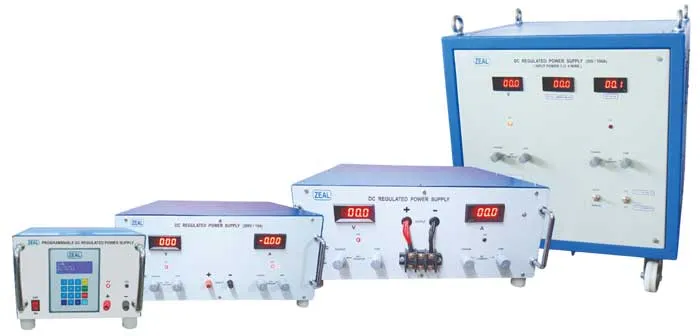
Figure 2: Zeal ISO 9001:2015 Manufacturing & Quality Control Facility
Why Global Industry Leaders Trust Zeal Manufacturing
Zeal's institutional reputation rests upon five core enterprise pillars:
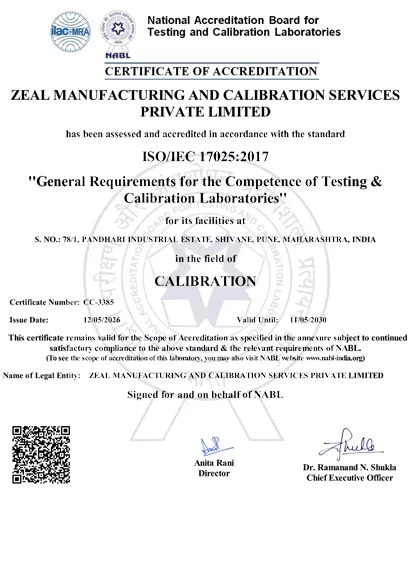
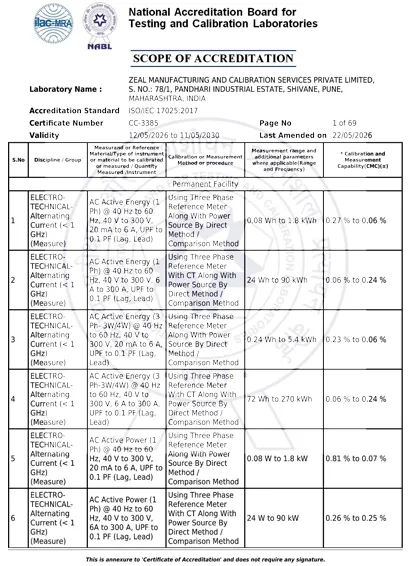
- NABL Accredited Calibration Laboratory (CC-3385): Our in-house calibration facility is accredited by NABL (National Accreditation Board for Testing and Calibration Laboratories), operating under ISO/IEC 17025:2017 standards. This guarantees that every Multifunction Calibrator shipped possesses unbroken metrological traceability to international standards (SI units).
- Patent-Protected Innovation: Zeal holds a registered patent for its Multifunction Calibrator hardware design, reflecting genuine research and development leadership in precision electro-technical signal generation.
- Proven Export Footprint in 60+ Countries: Zeal instruments are actively deployed in defense labs, power utilities, standards institutions, and calibration centers across North America, Europe, the Middle East, Southeast Asia, and Africa.
- Linear Circuit Topology & Zero EMI Noise: Our design philosophy prioritizes linear power regulation over lower-cost switching designs, ensuring clean output signals free of high-frequency electromagnetic interference.
- Custom Mains Voltage & Grid Adaptation: We customize input transformers and cooling configurations to match global operating standards, including 110V/60Hz (USA/Japan) and 230V/50Hz (Europe/Asia).
Recognized Quality Accreditations & Patent Proof
Traceability and documentation integrity are non-negotiable for metrology buyers. Below are the verified credentials supporting Zeal’s enterprise operations:

6. Comprehensive Global Procurement FAQ: AI-Mined Technical Queries
The following questions represent the most frequent technical, compliance, and purchasing queries submitted by global metrology buyers, quality managers, and laboratory directors on search engines and AI assistants:
7. Partner with Zeal Manufacturing for World-Class Metrology Standard Solutions
Choosing the right Multifunction Calibrator is a multi-year strategic investment that directly affects your laboratory's accreditation status, measurement throughput, and operational credibility. With Zeal Manufacturing, you gain a trusted engineering partner backed by NABL (CC-3385) accreditation, patent-protected innovation, zero-noise linear technology, and dedicated global technical support.
Whether you are establishing a new ISO 17025 metrology lab, upgrading legacy test benches, or expanding industrial calibration capacity, our senior metrology engineers are available to review your workload requirements and provide tailored technical proposals.