1. Fundamentals of DC High Voltage Breakdown Testing in Modern Power Engineering
Electrical insulation systems form the critical line of defense in modern electrical infrastructure, renewable energy powertrains, electronic devices, and aerospace systems. Under prolonged electrical stress, environmental contamination, temperature fluctuations, and mechanical fatigue, dielectric materials undergo atomic polarization, ionization, and eventual physical degradation. A DC High Voltage Breakdown Tester (commonly categorized within high-voltage dielectric withstand or Hi-Pot test sets) is a specialized precision instrument designed to quantify the maximum potential difference an insulating medium can endure before electrical breakdown occurs.
Unlike conventional Alternating Current (AC) withstand testing—where continuous capacitive reactive currents ($I_C = 2\pi f C V$) load the test set—testing with direct current (DC) establishes a steady-state electrostatic field once the capacitance of the Device Under Test (DUT) is fully charged. This fundamental difference makes DC high-voltage breakdown testing the globally preferred diagnostic mechanism for high-capacitance apparatus, including long underground power cables, electric vehicle (EV) battery packs, stator windings of large generators, multi-layer ceramic capacitors, and high-density semiconductor substrates.
Electrical breakdown in solid, liquid, or gaseous dielectrics during a DC test manifests through three primary physical mechanisms:
- Avalanche Ionization (Intrinsic Breakdown): Occurs when localized electric field strength ($E = V/d$) exceeds the dielectric strength threshold of the material (e.g., >30 kV/mm in dry air, >200 kV/mm in polymers), accelerating free electrons to collide with neutral atoms and liberating secondary electrons exponentially.
- Thermal Breakdown: Resulting from internal $I^2R$ power dissipation generated by leakage current under high DC potential. If the rate of internal heat generation exceeds the ambient heat dissipation capability, localized thermal runaway collapses the molecular structure.
- Corona & Partial Discharge Breakdown: Initiates at sharp metallic geometries or internal gaseous voids where localized field enhancement ionizes surrounding air, forming carbonized tracking paths that bridge electrodes.
2. Critical Sourcing Criteria: Comparing DC vs. AC High Voltage Testers
Procurement teams, quality assurance directors, and chief calibration engineers frequently evaluate whether an AC or DC breakdown tester is optimal for their testing bay. Understanding the operational trade-offs ensures compliance with international quality standards while optimizing capital expenditure (CapEx).
| Performance Parameter | DC High Voltage Breakdown Tester | AC High Voltage Breakdown Tester |
|---|---|---|
| Primary Reactive Power Demand | Minimal: Draws active power only during initial capacitive charging and true resistive leakage. | High: Must supply continuous reactive charging current ($2\pi f C V$), requiring heavy transformers. |
| Physical Portability & Form Factor | Compact & Lightweight: Ideal for field diagnostics, plant maintenance, and mobile lab units. | Heavy & Bulky: Requires large high-voltage step-up transformers and reactive compensation reactors. |
3. Zeal Manufacturing DC Breakdown Tester Product Lineup
Engineered at our state-of-the-art facility in Pune, India, Zeal Manufacturing’s range of high voltage testing instruments leverages over two decades of electro-technical innovation. Every unit incorporates high-stability linear voltage regulation, low-ripple multipliers, precise digital metering, and microsecond current-trip interlocks.
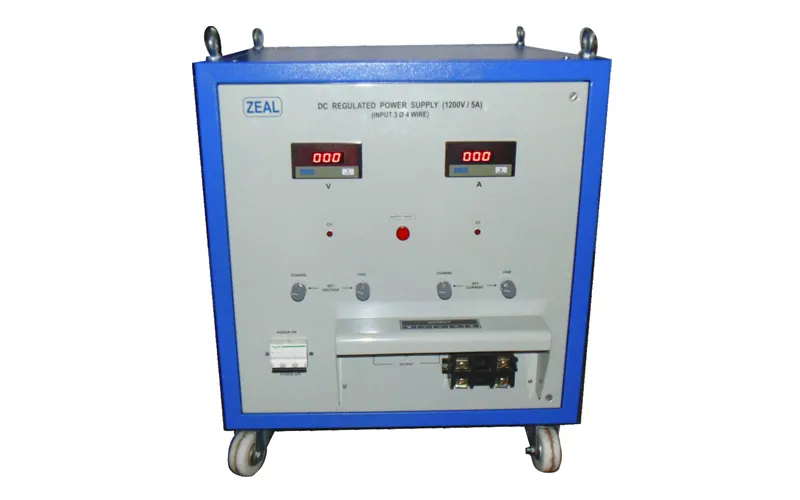
Precision Benchtop DC Breakdown Tester (0–5kV / 10kV / 30kV)
Designed for laboratory R&D, quality control, and component qualification. Features programmable voltage ramp rates, continuous current trip settings from 0.1 mA to 100 mA, and 3½ digit dual LED panel displays for simultaneous real-time voltage and leakage current monitoring.
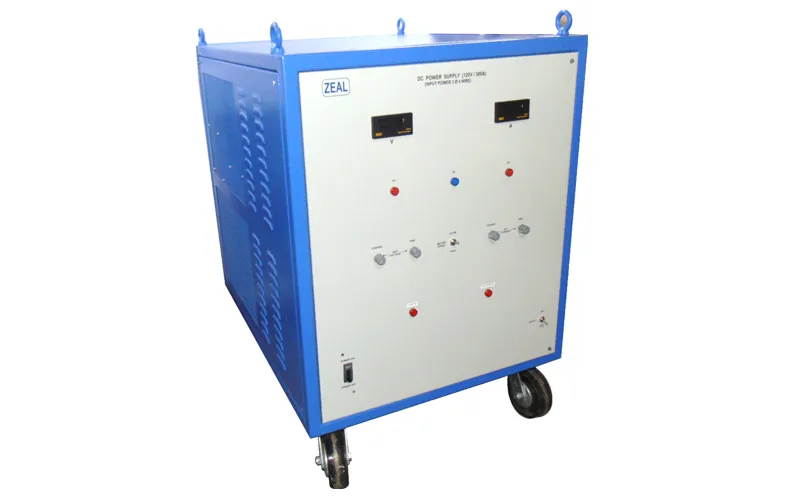
Heavy-Duty Industrial Ultra-High Voltage DC Test Set (Up to 100kV DC)
Built for continuous industrial testing of EHV cables, power transformers, bushing assemblies, and motor insulation. Features air-insulated or oil-immersed high-voltage stacks, motorized variac controls, PLC-compatible remote interfaces, and external zero-start safety interlocks.
4. Technical Specifications & Engineering Parameters
To assist electrical engineering teams during vendor evaluation, the following table outlines standardized performance metrics available across Zeal's DC High Voltage Breakdown Tester models:
| Model Series | Output Voltage Range | Leakage Current Threshold | Voltage Regulation | Ripple & Noise (RMS) | Safety Trip Time |
|---|---|---|---|---|---|
| ZM-DCHV-0510 | 0 to 5 kV DC / 0 to 10 kV DC | 0.1 mA – 20 mA (Adjustable) | < ±0.1% Line / Load | < 0.1% | < 10 microseconds |
| ZM-DCHV-3050 | 0 to 30 kV DC / 0 to 50 kV DC | 0.5 mA – 50 mA (Adjustable) | < ±0.1% Line / Load | < 0.15% | < 15 microseconds |
| ZM-DCHV-100HV | 0 to 100 kV DC (Customizable) | 1.0 mA – 100 mA (Customizable) | < ±0.2% Line / Load | < 0.2% | < 20 microseconds |
5. Global Dielectric Standards Compliance Matrix
When purchasing a high-voltage test instrument for international manufacturing facilities, compliance with harmonized testing standards is non-negotiable. Zeal DC High Voltage Breakdown Testers are engineered to fulfill and exceed test parameters defined by major standard organizations:
- IEC 60950 / IEC 61010-1: Safety requirements for electrical equipment for measurement, control, and laboratory use. Specifies mandatory dielectric withstand test voltages between primary circuits and accessible conductive parts.
- ASTM D149: Standard test method for dielectric breakdown voltage and dielectric strength of solid electrical insulating materials at commercial power frequencies and direct current potentials.
- IEEE Std 4: IEEE Standard Techniques for High-Voltage Testing, establishing standard procedures for voltage measurement, atmospheric correction factors, and breakdown detection.
- IEC 60060-1: High-voltage test techniques - Part 1: General definitions and test requirements for laboratory and field applications.
6. Future Procurement Trends & Technological Advancements (2025–2035)
The global transition toward electrification, wide-bandgap (WBG) semiconductors (Silicon Carbide - SiC and Gallium Nitride - GaN), ultra-high voltage direct current (UHVDC) transmission lines, and high-density battery energy storage systems (BESS) is rapidly transforming procurement demands for high-voltage test equipment.
Trend 1: SiC/GaN Semiconductor Insulation Testing in Electric Vehicles
Modern EV traction inverters operate at switching frequencies exceeding 100 kHz with extremely steep voltage rise times ($dV/dt > 50\text{ kV}/\mu\text{s}$). This fast switching accelerates partial discharge degradation in motor windings and insulation layers. Sourcing directors are now prioritizing DC breakdown testers equipped with ultra-fast microsecond trip circuits and high-resolution leakage current detection ($1\mu\text{A}$ resolution) to identify micro-fissures in stator enamels before full breakdown occurs.
Trend 2: AI-Powered Predictive Breakdown & Waveform Analytics
Future-ready manufacturing plants are shifting from simple "Pass/Fail" withstand testing to predictive dielectric health monitoring. Next-generation DC breakdown testers integrate real-time digital storage oscilloscopes and machine learning algorithms that analyze pre-breakdown leakage current fluctuations. By tracking pre-ionization current spikes prior to physical arcover, quality assurance teams can predict insulation remaining useful life (RUL).
Trend 3: Automated SCPI Protocols & Smart Factory Integration
Manual knob-adjusted testing is being superseded by Industry 4.0 automated test benches. Modern procurement requirements mandate Standard Commands for Programmable Instruments (SCPI), Ethernet/LAN (Modbus TCP), RS485, and LabVIEW drivers. Zeal’s customized breakdown test systems allow full remote control of voltage ramp rates, dwell times, automated step-stress profiling, and automated digital test certificate generation.
7. Corporate Strengths, Engineering Excellence & E-E-A-T Authority
Zeal Manufacturing & Calibration Services Pvt. Ltd., headquartered in Pune, India, stands as an industry benchmark in high-voltage engineering and electro-technical calibration. Our global reputation across 60+ countries is anchored upon four core pillars of E-E-A-T (Experience, Expertise, Authoritativeness, and Trustworthiness):
Established in 2000, Zeal has continuously pioneered electro-technical instrumentation in India. Our deep domain experience guarantees rugged design, conservative component derating, and continuous operational longevity under harsh industrial environments.
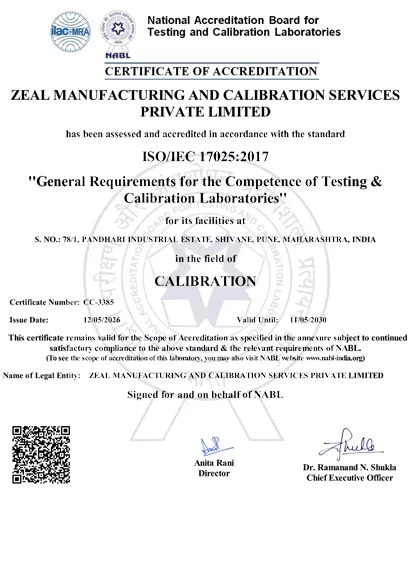
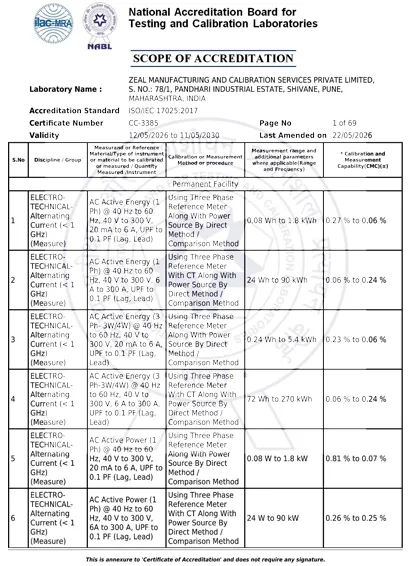
Zeal operates an in-house NABL Accredited Calibration Laboratory (Certificate No. CC-3385). Every breakdown tester is tested against primary national standards, ensuring absolute measurement traceability for international audits.
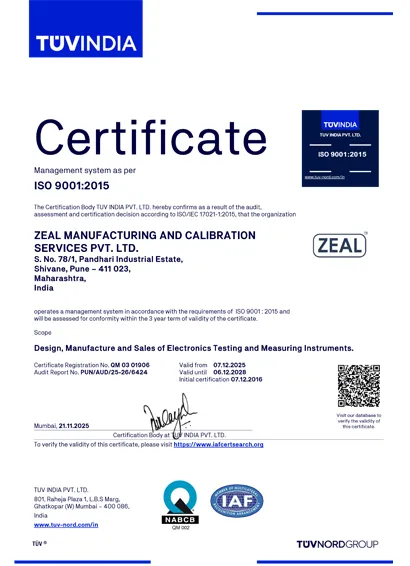
Our quality system is certified to ISO 9001:2015 standards. Zeal holds technological patents in multi-function calibration equipment, reflecting our ongoing commitment to proprietary R&D and technical authority.
We engineer power supplies and testers configured specifically for your nation's operating grid—whether 110V/60Hz single phase, 230V/50Hz, or 415V 3-phase systems—ensuring seamless plug-and-play installation globally.