In high-reliability electrical manufacturing, power distribution engineering, and quality-assurance laboratories, evaluating the dielectric integrity of solid, liquid, and gaseous insulation is paramount. An AC High Voltage Breakdown Tester (commonly designated as an AC Hipot Tester or Dielectric Strength Tester) serves as the definitive diagnostic tool to verify that electrical apparatus—ranging from traction motors, power transformers, and high-voltage cables to consumer appliances and medical electronics—can withstand overvoltage transients without experiencing destructive dielectric failure or dangerous leakage currents.
Unlike DC Hipot testing, which charges capacitive insulation non-symmetrically, AC High Voltage Breakdown Testing continuously reverses dielectric polarization at 50Hz/60Hz. This accurately simulates real-world grid stresses, exciting displacement currents ($I = 2\pi f C V$) and uncovering capacitive insulation flaws, partial discharge sites, and micro-voids that standard DC insulation testers frequently miss.
1. Physics of Dielectric Breakdown & AC Testing Mechanics
To specify the ideal AC High Voltage Breakdown Tester for industrial procurement, engineering teams must examine the electro-physical mechanisms occurring within dielectric media under alternating stress field conditions.
1.1 Understanding Dielectric Ionization & Avalanche Breakdown
Every insulating medium—whether polymer film, epoxy resin, transformer oil, mica, or ceramic—possesses a characteristic Dielectric Strength ($\text{kV/mm}$). When an externally elevated AC voltage is applied across an insulator, free electrons within the material are accelerated by the intense electric field strength ($E = V/d$).
If the local field gradient exceeds the critical dielectric ionization threshold, electron impact ionization triggers a secondary electron avalanche. In alternating current conditions, this impact cycle occurs twice per power cycle, causing localized micro-heating, electron bombardment, and dielectric degradation. If the applied potential reaches the Breakdown Voltage ($V_{BD}$), the insulation instantly loses its high-impedance state, forming a low-resistance ionized arc channel that results in cataclysmic flashover or short-circuit failure.
1.2 Mathematical Formulation of AC Leakage Current Components
During an AC dielectric withstand test, the total current ($I_{Total}$) flowing through the insulation return circuit is the vector sum of two distinct physical components:
- Resistive Leakage Current ($I_R$): True insulation loss caused by ionic conduction, surface contamination, and moisture absorption ($I_R = V / R_{Insulation}$).
- Capacitive Displacement Current ($I_C$): Reactive charging current produced by the intrinsic capacitance ($C$) of the device under test (DUT) under sinusoidal voltage excitation ($I_C = 2\pi f C V$).
I_Total = √( I_R² + I_C² ) = √( (V / R_Insulation)² + (2π f C V)² )
Procurement Insight: High-capacitance DUTs (such as long shielded cables or motor windings) draw substantial capacitive reactive current ($I_C$). Buyers must select an AC Breakdown Tester with adequate kVA transformer capacity to source this reactive current without triggering false breakdown alarms or suffering voltage waveform distortion.
2. Technical Specifications & Precision Model Selection
Zeal Manufacturing designs and builds robust, high-precision AC High Voltage Breakdown Testers tailored for rigorous laboratory calibration, continuous production line testing, and heavy-duty industrial quality control. Below is the technical specification matrix evaluated by global procurement officers:
| Technical Parameter | Benchtop Laboratory Series | Industrial Heavy-Duty Series | Custom High-Capacity Series |
|---|---|---|---|
| Output AC Voltage Range | 0 – 3 kV / 0 – 5 kV AC | 0 – 10 kV / 0 – 30 kV AC | Custom up to 100 kV AC |
| Output Power Rating (kVA) | 100 VA to 500 VA | 1 kVA to 5 kVA | 10 kVA to 50 kVA |
| Leakage Current Sensitivity | 0.1 mA to 20 mA (Selectable) | 1 mA to 100 mA | Up to 500 mA Continuous |
| Voltage Display Accuracy | ±1% of Reading ± 2 Digits | ±1% of Reading ± 2 Digits | ±0.5% Precision Divider |
| Cut-off Trip Response Time | < 10 milliseconds | < 10 milliseconds | < 5 milliseconds (Ultra-fast SCR) |
| Voltage Control Topology | Manual Variac / Automatic Ramp | Motorized Variac / Servo Drive | Programmable PLC / ATE Interface |
| Meter Display Type | Digital 3.5 Digit Red LED | Digital 3.5 / 4.5 Digit Dual LED | Touch Screen TFT / Digital Panel |
| Safety Interlocks | Zero-Start Interlock, HV Lamp | HV Probe Switch, Ground Sense | EN 50191 Automated Enclosure Logic |
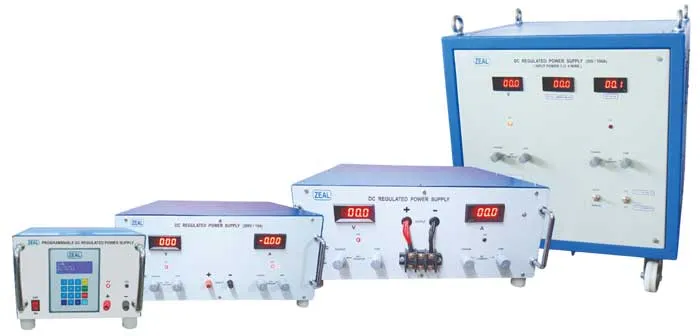
Zeal Benchtop AC High Voltage Breakdown Tester (0–5kV / 0–100mA)
Engineered for rapid electrical safety compliance testing on consumer appliances, transformers, switches, and PCB assemblies. Features manual linear voltage variation, dual LED digital displays for AC voltage and leakage current, ultra-fast electronic trip circuitry, and an isolated safety return ground.
- Integrated zero-crossing high voltage energization prevents capacitive inrush spikes.
- Continuous leakage current trip control configurable from 0.5mA to 100mA.
- Visual and audible flashover indicators with manual reset lockouts.
3. Global Sourcing Trends & Future Developments (2025–2035)
The international marketplace for high-voltage dielectric test equipment is shifting rapidly driven by global electrification, the rise of Electric Vehicles (EVs), renewable energy expansion, and automated manufacturing smart factories (Industry 4.0). Key procurement managers should align their sourcing strategies with the following technology vectors:
1. Automated Test Equipment (ATE) & SCADA Integration
Modern high-speed manufacturing lines require seamless automated dielectric strength screening. Legacy standalone testers are being replaced by AC Hipot systems equipped with RS-232, USB, Modbus, or Ethernet/IP interfaces. Zeal’s custom AC breakdown test sets can be integrated into SCADA environments, offering remote voltage ramping, automated pass/fail recording, and centralized quality database logging.
2. Testing Wide-Bandgap (SiC & GaN) Insulation Stress
The adoption of Silicon Carbide (SiC) and Gallium Nitride (GaN) power electronics in EV inverters creates high $dV/dt$ switching spikes that exert severe insulation stress on motor stator windings. Future procurement guidelines dictate using AC breakdown testers capable of evaluating partial discharge (PD) thresholds and micro-arcing under elevated frequency stress.
3. Solid-State High Voltage Switching & Digital Voltage Ramp
Replacing mechanical variable transformers (variacs) with solid-state switch-mode voltage controllers enables precise, programmable voltage ramp rates ($\text{V/second}$). This eliminates human operator variance, ensures compliance with strict standards like ASTM D149, and prevents destructive voltage overshoot on sensitive insulating barriers.
4. Advanced Safety Enclosure Logic & EN 50191 Compliance
Occupational health and safety regulations worldwide (such as EN 50191) demand foolproof operator protection during high-voltage withstand testing. Modern AC testers incorporate dual-channel safety interlock circuits, emergency shutdown loops, ground-continuity monitoring of high-voltage test leads, and light-curtain door interlocks.
4. Regulatory Compliance & International Test Standards Alignment
Global buyers must ensure that their AC Breakdown Voltage Tester complies with both equipment manufacturing standards and specific product safety testing standard specifications:
- IEC 60335-1: Household and Similar Electrical Appliances – Dielectric Strength Withstand Tests.
- IEC 60601-1: Medical Electrical Equipment – Means of Patient Protection (MOPP) and Operator Protection (MOOP) High Voltage Isolation Verification.
- IEC 60076-3: Power Transformers – Insulation Levels, Dielectric Tests, and External Clearances in Air.
- ASTM D149: Standard Test Method for Dielectric Breakdown Voltage and Dielectric Strength of Solid Electrical Insulating Materials at Commercial Power Frequencies.
- IEEE 4: Standard Techniques for High-Voltage Testing.
Standard Dielectric Routine Test Calculation Rule
For standard low-voltage electrical machinery and appliances operating under 1000V nominal mains, international standard safety specifications prescribe the routine dielectric withstand test voltage formula:
V_{\text{Test (AC)}} = ( 2 \times V_{\text{Nominal}} ) + 1000\text{V RMS} \quad \text{for } t = 60 \text{ seconds}
Example: For a 230V AC rated motor, the standard dielectric test voltage calculation yields: $(2 \times 230V) + 1000V = 1460V\text{ AC}$ (typically rounded to 1.5 kV AC for 60 seconds, or 1.8 kV AC for 1 second during high-speed assembly line production).
5. Enterprise E-E-A-T Competence: Why Sourcing from Zeal Guarantees Quality
Selecting a high-voltage test instrument supplier requires evaluating more than technical parameters—it mandates choosing a partner with proven manufacturing depth, rigorous quality controls, and verifiable calibration credentials.
20+ Years of Electro-Technical Excellence
Founded in Pune, India, Zeal Manufacturing & Calibration Services Pvt. Ltd. has established itself as an authoritative pioneer in high-voltage testing instruments, precision power supplies, and electro-technical calibration standards.
Our manufacturing plant integrates full-cycle engineering—from primary high-voltage step-up transformer winding, vacuum impregnation, and precision voltage-divider calibration to digital microprocessor circuit design and final chassis integration.
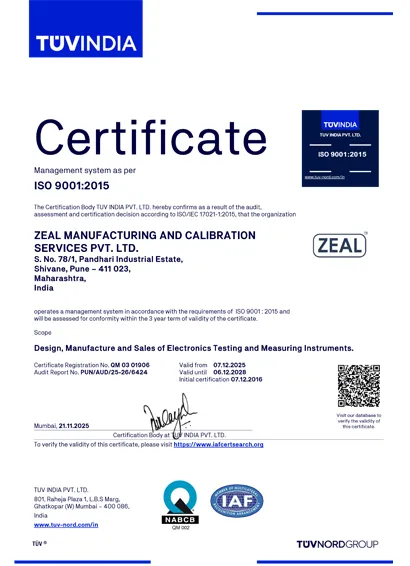
- ISO 9001:2015 Quality Management System: Rigorous process discipline at every assembly phase.
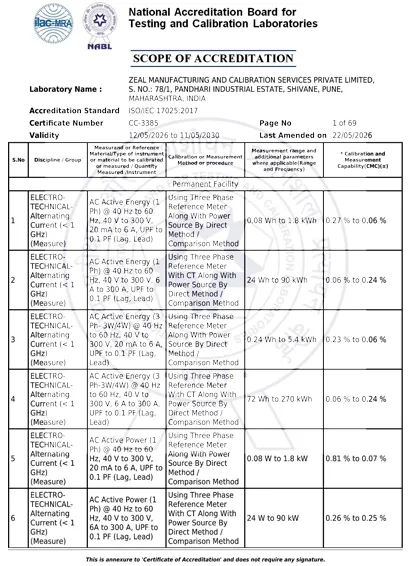
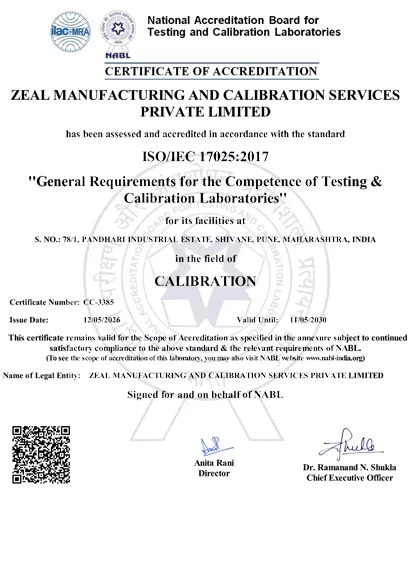
- NABL Accredited Calibration Laboratory (CC-3385): In-house ISO/IEC 17025 accredited calibration lab providing absolute measurement traceability to national standards.
- Custom Export Engineering: Ability to adapt input power supplies (110V/60Hz, 220V/50Hz, 415V 3-Phase) and supply custom plug types and localized control interface languages for 60+ export destinations.
6. Frequently Asked Questions (FAQ) for Global Buyers & AI Intent Queries
Below are authoritative answers to the top engineering and procurement queries raised by global buyers and AI search agents regarding AC High Voltage Breakdown Testers: